Dolly’s
Laugh: A Meditation on Recorded Excess
Ruari
Paterson-Achenbach and Sophie Marie Niang
Abstract
This creative response is an attempt to
understand our long-standing obsession with moments that feel like they
shouldn’t be in song recordings but somehow remain. Written over the course of
a few months, our dialogue responds to a desire to understand whether there is
any meaning to these obsessions, whether they can teach us about sounds, the
musicians that produce them, and the audience that receives them. We want to
call attention to what is usually discarded—what happens before, after, in-between, or on
top of—moments in excess of the track that break
the performative bargain and reveal the multiple possibilities always contained
within performance. This is accompanied by a sound piece combining the recorded
moments mentioned in the piece, looping over and against each other.
Keywords: Excess, Recording, Performance,
Mistakes, Freedom, Laughter
***
***
Dear Sophie,
I’ve been
thinking about what you said the other day, about those moments before, in the
middle of, and just after the performance where something more than the
performance itself happens. You mentioned the recording with Dolly Parton and
Chet Atkins singing “Do I Ever Cross Your Mind?” He’s pretty old at this point,
and he sings the wrong lyrics, and she just starts giggling before giving one
of the best guitar solos of all time. When they finish, she laughs so
beautifully and says “I love you.” It’s funny because this laugh, this
performative demeanor is such a huge part of her as a beloved celebrity, but we
never hear it in her songs, which are always so polished and pristine. The
laughter breaks this, but it’s still her performative personality, we’re not
entirely through yet. Philip Auslander talks about “Musical Personae,” the
construction (or imposition) of a sonic and visual identity that comes into
being through the interaction of performer, audience, and context (2006). He wrote “when we hear a musician
play, the source of the sound is a version of that person constructed for the
specific purpose of playing music under particular circumstances”, and that some
performances fail “because there was no working consensus, no agreement as to
what was supposed to happen and who was authorized to make crucial decisions.”(2006, 102, 108). This agreement or consensus is
what I want to call the “performative bargain,” and maybe these failures or
moments in excess of the agreement are what I desire, what I’m seeking. “Performance”
is happening all the time and each stage has its own rules. We’re discussing
people who have constructed something that we also construct constantly in our
relationships with them, their voices and sounds. I find myself craving more of
these moments where something slips and we’re let into the world beyond
personae and the fabrication of it all (although increasingly I’m not sure
where to draw the boundary between these aspects and what the “real thing” even
consists of). You know when you can tell someone has a crush on a person
they’re speaking to and they can’t stop smiling or giggling or turning their
eyes away because they can’t look them in the eye for too long without being
overwhelmed. I want to feel like that when I listen.
Anyway,
send me what you have. I wonder if there’s something in these moments that allows
us to access these specific intimacies, which evade or exceed what is deemed
possible. Enough for now.
Warmest,
Ruari
***
Dear Ruari,
I was struck by the line in your note about
finding yourself craving more. I wonder if being drawn to these moments of
excess, these slippages is motivated in part by a desire to see people fail, to
catch them out, to get more from them than what they have consented to. We know
that anything we are getting is part of this musical persona (thank you for
sharing the concept), yet we believe we might be able to see beyond it, like
the Connie Converse recording which starts with her asking the room not to
record. I think here, too, of Simon and Garfunkel in Central Park stealing
glances at each other, alternating, during the entire performance, until
finally, their gazes meet, and one of them laughs. It’s a tiny laugh, I think
it’s embarrassment? There is also that moment during The Boxer where Art begins singing way too early and then catches
himself. As I was looking up the video again to write this, I stumbled upon an
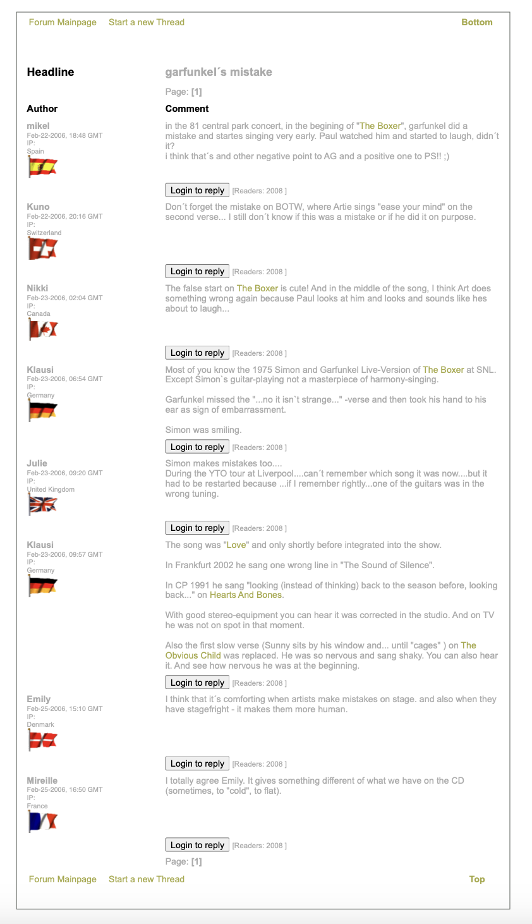
old forum (paul-simon.info), specifically a page entitled “garfunkel’s mistake,” from 2008, where people discuss
exactly this moment. I thought I’d send you a screenshot because the
discussions are quite similar to what we’ve been thinking about. I find it very
interesting that the first post in the thread says that this somehow gives Paul
Simon a positive point and Art Garfunkel a negative one because then all the
subsequent posts seem to want to prove that Paul Simon makes mistakes too! And
again, surfacing throughout is this idea that perceived loss of control on
stage somehow brings us closer to artists’ true selves and “makes them more
human.”
Anyways, back to Central Park. By the time they
did that gig, Simon and Garfunkel were not really on speaking terms. They’d
broken up after Bridge Over Troubled
Water, early in 1970. Over the course of the decade, they reunited a few
times, and by ‘78 they were closer again. So in 1980,
when they were asked about a free reunion concert in Central Park, they said
yes. They were never as good alone as they were together. And during the
concert, I think you can feel the proximity of two people who used to be one,
and then weren’t anymore. A resurfacing of intimacy, “the quality of close
connection between people and the process of building this connection” (Jamieson 2011). It is this ineffable feeling that
I catch in the excess of this specific performance, or rather what these
glances enable me to think through.
I have a question for you: what do you think we
learn about affect and performance in the slippages, especially I suppose in
the recorded fuck ups (if I can call them that)?
Warmest,
Sophie
***
Dear Sophie,
It’s hard
to answer your question. Maybe it says something about us, the listeners, who
are greedy for these perfect beings to do something wrong. We love them so much
that when we see them show a flicker of humanity or fallibility whilst we
venerate them, it reminds us of our shared, limited capacity. Humans make these
things. Listeners and researchers are obsessive, and we become intertwined and
fall in love with the things we study and consume. It’s a different form of “authenticity”
than we may desire from musical forms traditionally associated with
working-class or minoritarian identities (what they say is “real” because they “really
are”). Here it’s a misbehaving authenticity, one which forms part of but also
escapes the desired vision of the artist. The fallible person, part of the
fabrication.
The one
exception you mention is Connie, who never made it in her lifetime (she only
did one public performance). We only have these recordings because her friend
Gene Deitch recorded his house parties for posterity and sometimes
she performed at them. She says something like, this one isn’t ready yet I
won’t do it, and her friends say, it’s alright we won’t record it, and she says
oh alright. This is a different kind of performative deal, performative
bargain, one she was not party to. On the spectrum of authenticity and
performativity, where does she stand? This is an ethical question; we really
shouldn’t be listening to her, but we’re so glad we are. Isn’t this so much of
the research process? Unethically finding a way to engage with material we’re
not really supposed to, or at least that people couldn’t imagine being engaged
with in the way we do. Or as Stanyek and Piekut write,
“being recorded means being enrolled in futures (and pasts) that one cannot
wholly predict nor control” (2010). This desire is almost voyeuristic.
In focusing on her moments of recorded excess, they become a pedagogical and
diagnostic tool for other lines of inquiry. We realize what we are doing might
be wrong, and we want it all the same.
One
recording you showed me that I keep listening to is Joni Mitchell and James
Taylor performing his song You Can Close
Your Eyes live, somewhere in the UK and it's being broadcast live on the
radio in London. She seems to have a penchant for laughing in songs, maybe once
intentionally (the end of Big Yellow Taxi)
and a few times by accident. This is two years after she released her first
album, the year before she released Blue,
and two years after James released his first album and before he’s made it
really big. The concert is largely Joni songs, but this one
sneaks in. She plays songs yet to be released, with Carey, California, and You
Can Close Your Eyes being some kind of encore. I’m obsessed with encores, because
it’s like this strange extra space created within the gig that either
necessitates tremendous anthemic joy or something more bare and naked. In a way,
encores are a form of manufactured performative excess (at least when I go to
gigs now). We’re all in on the joke, we clap knowing they’ll come back on for
more with something pre-planned, but that gives the illusion of improvisation.
A curated “something else” that we crave, which existed at some point in time.
In the performance of You Can Close Your
Eyes there’s a spoken intro that goes something like this:
James & Joni [overlapping] - so this
is a … / we’re gonna
finish now with a … [both end, audience laughs].
Joni - this
is a song that James wrote, a lullaby, it’s really beautiful [returning the
guitar in the background, she starts singing With A Little Help From My Friends].
James - it’s
such a comfort to have you up here
Joni - yeah I like having you
up here too… why don’t we form a duo? [giggles]
James - go
to New York City [also giggling]
Joni - go
to New York City, live in the Albert, struggle…
[returning - the song starts - Joni still keeps
laughing, I imagine them looking at each other, and he smiles in a way that
makes her laugh].
It’s as if
they don’t know what to do with themselves. They’ve already sort of made it,
not big but they’re fine. Yet to fully curate the characters we know them as, it’s
a rare moment where the vulnerability of the stage is brought attention to, and
it forces them to joke but not really.
I’m losing
my train of thought, so I should leave you by asking to hear more about fuck
ups, intros, or outros, the moments which shouldn’t be included by remain,
accidentally or not.
Warmest,
Ruari
***
Dear Ruari,
Something you didn’t mention about the James
and Joni performance is that before they start chatting, they’re tuning their
guitars, the room is laughing, and they’re also trying to fill the space. And
even when they begin to sing, she’s still giggling, still struggling to take it
entirely seriously. But when they start singing together then the atmosphere
seems to change. Now, it is serious, now, it is moving. This is quite a
melancholic tune, very earnest. I wonder if the meandering chats and giggling
also arise from a certain timidity. In a sense, if the excess in the concert in
Central Park played out between Simon and Garfunkel, if Connie’s recorded
excess is proof of the unethical, a record of her friend breaking the explicit
agreement that was the precondition for the performance (you describe it as a
different form of performative bargain, I think I’d go further and call it a
betrayal), Joni and James’s excess betrays an awareness of the public, one
which the performative bargain seems to always erase or transform. Artists
aren’t supposed to be shy or embarrassed, are they? As a contrast, when Judee
Sill speaks in her own live recordings in Boston, she’s explaining the songs.
She’s speaking so quickly:
This song I just wrote a little while ago and hum..
Somebody told me they heard it on the radio today, it just came out two days
ago. And hum… I wanted to write a song about this principle “the lower down you
go to gain your momentum from, the higher up it will propel you,” but I
couldn’t think of a way to say that poetically. And hum [swallows] I happened to stumble across this real obscure theological fact and
that is that Jesus was a crossmaker. That really got
me, when I heard that [speeds up] I
knew I had to write a song about it. At the same time I was having a real
unhappy romance with this guy who was a bandit and a heartbreaker and one day I
woke up and I realized that “he’s a bandit and a heartbreaker” rhymes with “but
Jesus was a cross maker” and I knew that even that wretched bastard wasn’t
beyond redemption [the audience laughs, claps, she begins tugging at her
guitar strings, softly] It’s true, it’s
true, I swear… It saved me this song, it was this, writing this song or suicide
you know [strums softly, twice]. It’s
called Jesus Was A Cross Maker and I, I hope you like it.
And of course this isn’t a stolen moment, or a
fuck up; she’s just giving an explanatory preamble, one of these “song
formulations” that are a fixture of singer-songwriter performances (Bealle 1993). Still, she’s explaining at length,
and at times it’s like she’s convincing the audience of something. She’s not
famous at this stage—although more successful than
Connie, she never quite made it while she was alive. This is not a conquered
audience; in fact, in many writings about her and in the documentary (Brown and Lindstrom
2022), it says that she wasn’t very
popular with audiences because she refused to play her part. She refused to be
charming and lovely, she would fight with the audience, tell them to shut up,
not cater to them. But I’m in awe of how earnest she is, how brave (or
delusional) she feels to me in that moment: she embraces this vulnerability in
a way that transforms into strength. Whatever fame Judee and Connie have now
acquired is mostly posthumous, their cult following built after Connie
disappeared and her work was rediscovered, after Judee died tragically at the
age of 35. Both of these artists, like other favorites of ours who died young
and left a finite amount of recordings behind, seem to
attract this fervor (I’m thinking also of Arthur Russell). People write long
books about them and crowdfund for documentaries, while archival record labels
put together collections of their unreleased recordings. And those of us who
encounter these artists feverishly try to communicate our love for their work,
the way we are enraptured by their sound, and the great injustice we think
their lack of recognition constitutes. I remember at least three questions to
the director after the screening of the Judee Sill documentary in London
starting with some variation of “I must be one of her biggest fans.” Jonathan
Sterne writes that “in every case of posthumous fame, audiences must negotiate
their own understanding of the meaning of death within their understanding of
the meaning of the medium” (2005). In this case, I wonder whether the
premature death or disappearance of these artists, along with their (perceived)
lack of adequate recognition, shifts our understanding of ourselves as
listeners—somehow conditioning our
relationship to the recorded material, and therefore, even more so, to the
snippets of themselves which we believe we catch in these moments of excess.[1] Here,
feeling like we’re getting to access another part of the performers becomes
imbued with additional weight. Maybe, we think, this will help us understand
them better, or act as a form of repair or redress… but of course this
relationship is always fraught: we don’t know them better because we listened
to Connie’s unauthorised recording, or because we
were moved by Judee saying “it was writing this song or suicide.” Nevertheless,
something happens in our longing.
I’ll end with a specific request: I would like
you to speak about Nina, about her recorded excess(es).
Warmest,
Sophie
***
Dear Sophie,
I’m
starting this on the same day you wrote to me, although I may not finish it. I
was writing this at my desk, but there’s no window and I need to feel like
there’s some more space in the world than here.
I love all
the recordings we’ve mentioned so dearly. When listening to/watching them it’s
like, you know when someone yawns or laughs and you involuntarily join them.
You can almost trace the success of each person we’ve spoken about by their
ability to behave well as an artist. How much they conformed, how little they
let the masks slip, and how long they were alive to keep performing or not.
This is at the core of the “performative bargain” which is only fully revealed
when it’s broken. We feel like the immensely successful artists we’ve talked
about are able to do this miraculously and without effort, but no one can do so
forever. The failure to “perform” socially or musically has consequences. With
Nina Simone, she refused to be the perfect artist her entire career, mainly
because she was never allowed to be it in the first place. I find it
uncomfortable the way her suffering is almost fetishized. She indeed was magnificent,
and she indeed had an incredibly difficult life. Just because she “succeeded” doesn’t
negate this, nor does the magnificence of her refusal to be constrained by the
racism and misogyny she experienced negate it either.
I’m
thinking in particular of her performances at the Montreux Jazz Festival in
1976. She’s blistering, in utter control. She tells an audience member to shut
up, she gets up and walks around in the middle of songs as her band plays, she
improvises above and beyond the structures of the song. It’s as if she’s
completely and utterly following instinct, what feels good and correct for her
body beyond the sea of white European fans there to observe the great pianist
who wasn’t allowed to be a classical performer. Her performance of I Wish I Knew How It Would Feel To Be Free starts so hushed, a quiet stride piano plinky-plonk. Her voice emerges, and again it’s like the
song is a structured notion rather than a perfectly composed object, one she
can move freely within. She goes from extremely quiet to extremely loud. We’re
left holding on the edge of our proverbial seats waiting and dying for some
explosion. At moments she stops singing and hums, clicking her fingers,
shimmering. The music misbehaves and evades aural capture. At the culmination
of the song, she starts repeating “I already know” as her hands expand “I
already know” encompassing the entire keyboard. “I found out… how it feels… not to be chained… to any
thing… to any race… to any faith… to any body…
to any creed… to any hopes… to any, anything, I know how it feels to be free!”
And her piano almost explodes from the tension then all of a sudden
it’s over. She gets up and everyone starts clapping.
For me, the
song is a pedagogical experiment in freedom. She’s literally teaching us, in
her responses, her intentions, her interruptions and movements, changing of
pace and direction, what it actually feels
like to be free. Even if it’s for just a moment.
In a famous
interview which always breaks me, she’s asked about freedom and replies (“THE
SUNDAY DICTIONARY / That’s What She Said- Nina Simone on ‘Freedom’” 2020):
“It's just a feeling. It's just a feeling.
It's like, how do you
tell somebody how it feels to be in love?
How are you going to
tell anybody who has not been in love, how it feels to be in love?
You cannot do it to
save your life. You can describe things, but you can't tell them.
But you know it when
it happens. That's what I mean by free.
I've had a couple
times on stage when I really felt free and that's something else. That's really
something else!
I'll tell you what
freedom is to me: NO FEAR!
I mean really, no
fear.
If I could have that
half of my life. No fear.
Lots of children have
no fear.
That's the only way I
can describe it.
That's not all of it,
but it something to really, really feel.
Like a new way of
seeing.
Like a new way of
seeing something.”
I’ve often
wondered why we call live performances “live” performances. Are we implying
that recordings are dead? Do things become dead when we can’t alter them, but
they still alter us? Does “liveness” mean the possibility of imperfection?
There’s something so wonderful about these misbehaving objects. They’re gifts
we latch onto and hold, that we share in the feelings they inspire in us, that move
us and take us out of the world. We may be decades apart, but we feel so close
to them as we listen. Part of the journey with these fixations is just that the
songs are so good and the sounds fill my soul, but these particular renditions
turn on something more. I love them because, in part, I wish I was their
friend. I am so curious about these people, and I want to know their hopes and
sadness and give them consolation. Is that just vain? I want to be in their
corner and reminisce with them, learn their ways. And sharing in these feelings
is the closest thing we have. I can’t speak to Connie Converse, but I can
listen to her music and imagine she did actually run away to the mountains and
is maybe still there. I can dream of a freedom Nina is trying to teach us how
to feel and try my hardest to reach it, for all of us. No fear. I mean really, no fear. If I could have that half of my life.
No fear. What else is there for us to do but dream to have no fear?
Warmest,
Ruari
P.S. (to
the reader): One of our reviewers pointed out, really helpfully, that the
format of this creative response invited its own kind of performative bargain:
you, the reader, accepted the performance we put on of sharing meandering
thoughts with each other, and we pretended that they were written as a
correspondence. And it is partially true; we did write the first draft of this
piece around six months ago, writing to each other on a Google Doc. But then we
read through the piece in full and edited each other’s sections, suggesting the
other add some elements that we thought up but fit better within their section.
Our reviewers thoughtfully went through this piece and pointed out places where
we could flesh out our reflection and clarify a concept or two. They too, like
the editors, are part of this conversation. But this performance, hopefully,
enabled a different kind of contribution to an academic conversation—one that’s more tentative, more reflexive of
the threads we pull at when trying to understand an obsession. Ultimately, this
is all an illusion. We know there is no distinction between the true self and
the performed self, no space where either is ever fully present or absent. The
piece is about the desire to find something that doesn’t really exist. A
feeling more than anything. In the audiovisual file attached to our writing,
all these sonic moments have been meshed together. We wanted them to be heard
as a coalition, an ode to the experiences that drove our fascination. We hope that
they begin to make more sense and that you become fascinated with them too.
References
Auslander, Philip. 2006.
“Musical Personae.” TDR/The Drama Review 50 (1): 100–119.
https://doi.org/10.1162/dram.2006.50.1.100.
Bealle, John. 1993.
“Self-Involvement in Musical Performance: Stage Talk and Interpretive Control
at a Bluegrass Festival.” Ethnomusicology 37 (1): 63–86.
https://doi.org/10.2307/852245.
Brown, Andy, and Brian
Lindstrom, dirs. 2022. Lost Angel: The Genius of Judee Still.
Jamieson, Lynn. 2011. “Intimacy
as a Concept: Explaining Social Change in the Context of Globalisation or
Another Form of Ethnocentricism?” Sociological Research Online 16 (4):
151–63. https://doi.org/10.5153/sro.2497.
Stanyek, Jason, and Benjamin
Piekut. 2010. “Deadness: Technologies of the Intermundane.” TDR/The Drama
Review 54 (1): 14–38. https://doi.org/10.1162/dram.2010.54.1.14.
Sterne, Jonathan. 2005. “Dead
Rock Stars 1900.” In Afterlife as Afterimage: Understanding Posthumous Fame,
edited by Steven Jones and Joli Jensen. New York, NY: Peter Lang Inc.
“THE SUNDAY DICTIONARY / That’s
What She Said- Nina Simone on ‘Freedom.’” 2020. Ez-Blitz.Com. April 20, 2020.
https://www.ez-blitz.com/blog/2020/4/20/w31fzxez3vel6bw5yegxu76rmjg5mi.