Polyrhythmic
Cognition and Metric Spaces:
A Compositional
Framework
Louis-Michel Tougas
Abstract
This paper introduces a novel approach to rhythm-based
contemporary music composition. I propose that recent insights into the
cognitive limits of rhythm and meter can be translated into a compositional
framework that considers not only the structural and abstract properties of
rhythm structures, but also their perceptual impact on an audience. This method
enables the preservation of a high degree of structural complexity while
enhancing its perceptual effectiveness and minimizing notational intricacy. The
approach is facilitated by the use of OpenMusic, a computer-assisted composition software,
alongside a visual representation of metric modulation networks that I call a rhythm
lattice. To illustrate this approach, I present two examples from my recent
chamber music works.
Keywords: Metric Modulation; Ars Subtilior; Polyrhythm; Computer-Assisted Composition; Music Notation
Introduction
The abstraction that music notation offers—especially since
the advent of notation software and computer-aided and algorithmic composition
tools—also has the potential drawback of ignoring many important
considerations, including the performability, the perceptibility, and the
semantic and cultural ties that seemingly abstract musical structures may bear.
While the abstraction of rhythms into purely numeric
structures is a powerful tool for organizing and developing musical material,
these structures don’t necessarily take into account
how they will translate back into sound. Moreover, music notation is not a
style-agnostic language for the representation of sound. It is a culturally loaded
system of conventions that was developed with the goal of preserving the music
of the historical and cultural context in which it was developed. However,
approaching notated music composition by first forgetting the constraints of
standard music notation can serve as a powerful way to explore less obvious
aesthetic paths.
In this paper, I will present my personal polyrhythm-focused
compositional approach, informed by three main fields of research. The first
one is the study of music and music notation prior to the Western common
practice, which allowed for different possibilities of temporal expression. The
second perspective comes from the field of music perception and cognition. Many
critiques have been formulated against strictly structuralist approaches to
music composition throughout the second half of the twentieth century. However,
integrating knowledge from research on music cognition can help reconcile the
need for structural complexity and the perceptibility of such structures
without resorting to outdated forms of expression. The third aspect concerns
the use of computer-aided tools to synthesize structural and perceptual
constraints into a usable model for music composition. As part of this work, I
will present excerpts from two of my recent pieces to demonstrate the
alternative approach to notation I am using and the aesthetic potential it
unfolds.
Notation
The modern
music notation system in the Western world crystallized around the end of the
Renaissance (Bent
1998). Since
then, there have been few structural changes regarding how pitch or rhythm functions
within the notation itself. However, prior to this crystallization and
standardization, many alternative possibilities for the representation of music
had been developed (Maria
and Berger 2002). Perhaps the most
striking examples of this rich diversity of representational practices come
from the period called ars subtilior (more subtle art), transitioning between the
Middle Ages and the Renaissance in the context of the Great Schism that divided
the Catholic Church into two rival factions with their own pope, one based in
Rome and the other in Avignon (Apel
1946; Taruskin 2009).
The ars subtilior saw
the development of many different approaches to music notation, but perhaps the
most complex and obscure one is what Willi Apel calls “mannerist
notation,” which he discusses extensively in his Notation of Polyphonic
Music 900-1600. The use of hollowed and full noteheads, along with different
notehead colors (black, red, and blue), allowed for very complex possibilities
of rhythmic intricacies. The difficulty which the modern transcriber faces is
of particular interest to me, since it shows that notation is not merely a
representation of a more abstract process but the musical content itself, which
cannot easily be translated into any other language. As Apel describes, “It is
in this period that musical notation far exceeds its natural limitations as a
servant to music, but rather becomes its master, a goal in itself and an arena
for intellectual sophistries” (1949).
Just as
the ars subtilior
composers have adapted and expanded the notational innovations of the ars nova for their own expressive needs, I
believe that today’s music notation standards can be adapted to better fit
contemporary views of time as a multi-dimensional parameter.
Metrical Structures, Rhythm Perception, and Cognition
In their Generative Theory of Tonal Music (GTTM), Lerdahl and Jackendoff propose that the brain structures isochronous streams of pulses
hierarchically, and they define metrical structure as “the regular, hierarchical pattern of
beats to which the listener relates musical events” (1983). However, they also note that not all music exhibits metrical structure in this
sense:
“In fact, though all music groups into units of various kinds, some
music does not have metrical structure at all, in the specific sense that the
listener is unable to extrapolate from the musical signal a hierarchy of beats.
Examples that come immediately to mind are Gregorian chant […] and much
contemporary music […]” (1983,
17).
Numerous intermediary possibilities exist between a strictly hierarchical pulse
structure and completely arhythmic music. In particular, the simultaneity of
multiple isochronous streams—which form a polyrhythm—frequently produces perceptually ambiguous stimuli, as
each stream suggests more than one potential underlying metrical structure, as
described by Lerdahl and Jackendoff. Polyrhythms are perceptually intricate objects that can be
interpreted in a variety of ways, depending on the listener's focus. For this
reason, I consider polyrhythms a powerful tool for artistic expression, as they
embody both rational structure and perceptual openness.
While polyrhythms can exist within a purely hierarchical framework of
groupings and subdivisions, twenty-first-century musicians have access to a wider array of possibilities. These
often require a more decentralized approach to meter, one that may not adhere
to the predictable, well-ordered hierarchies of common-practice music. The concept of perceptibility is slippery and can
easily lead to over-simplifying musical structures, but integrating knowledge
related to how we perceive sound stimuli and how our brain treats and organizes
them can serve as a very powerful artistic approach. My personal approach to polyrhythm incorporates not only strictly
hierarchical pulses and integer-related subdivisions but also second-order
metric modulations and other complex techniques. These approaches often blur
the boundary between metricity and ametricity. I use this knowledge not as a set of limitations but as a means to explore alternative paths to temporal
complexity that are ideally going to be heard and felt by an audience.
In his
seminal work Hearing in Time: Psychological Aspects
of Musical Meter, Justin London summarized the research of a number of
previous research on limits regarding the cognition and perception of pulse and
meter and gave a detailed account of similar boundaries found by multiple
researchers over the years (2004,
28–30).
The
first set of boundaries indicates that isochronous sound stimuli are perceived
as pulsations if their constituent inter-onset interval is approximately
between 100 ms and 2000 ms (Bolton
1894; Hirsh 1959; Monahan and Hirsh 1990; Repp 2005). The inter-onset
interval (IOI) is the time between two sound events and corresponds to the
inverse of the frequency; for example, IOI of 1000 ms
is equivalent to a frequency of 1 Hz or to a metronomic value of 60 beats per minute
(bpm). As such, IOI values between 100 and 2000 ms correspond
to an upper limit of 600 bpm and a minimum of 30 bpm. While these values were
found in ideal laboratory conditions, many factors regarding the nature of the
sound stimuli themselves affect the perceptibility of their metricity.
Parameters such as the amplitude envelope of each pulse, their frequency
spectra, or an eventual masking effect caused by a competing sound source may
affect the clarity with which one can interpret a pulse train as metric or not.
For this reason, I use these values not as hard boundaries, but as good
indicators of what seems a reasonable temporal space to develop abstract
polyrhythmic structures that will translate into perceptually meaningful
stimuli once used in a musical composition and played by performers in a
concert hall. In all cases, the mere consciousness of speed limits for the
perceptibility of pulses provides a useful basis for the categorization of
different polyrhythms based on whether or not they
might be perceived as rhythmic stimuli at different moments during their
emission.
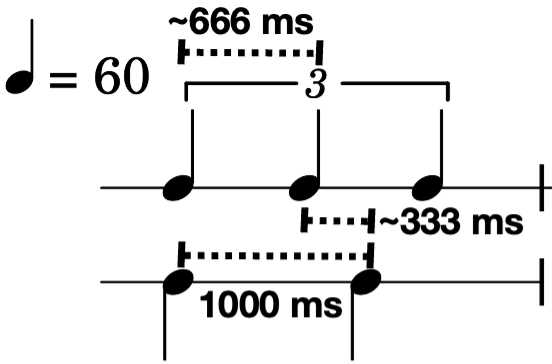
For example, Figure 1 presents a simple 3:2 polyrhythm, where the bottom voice is a quarter note pulse and the top voice a quarter note triplet. The written metronome mark in quarter note equals 60, indicating that the IOI of the bottom voice is 1000 ms. As the top voice is one and a half times faster (a 3-to-2 ratio) than the bottom one, we can calculate that its IOI will be of 1000 ms × 2/3 = ~666 ms. The distance between the second note of the top voice and the second note of the bottom voice is 1000 ms – ~666 ms = ~333 ms.
The common pulse denominator between two isochronous streams corresponds to the slowest subdivision shared by both streams. Numeric values can prove useful to find this common denominator, especially in the case of more complex polyrhythms. For Figure 1, the bottom voice is a succession of quarter notes (i.e., one-quarter of a whole note), which can be represented in numeric form as 1/4. In the top voice, one single pulse of the quarter note triplet is equal to a sixth of a whole note, or 1/6. The common pulse denominator can be found by dividing the greatest common factor (GCF) of both numerators by the least common multiple (LCM) of the denominators. This gives the value 1/12, or one pulse of an eighth note triplet, which corresponds to the difference between the second beat of both voices and has an IOI of about 333 ms, or frequency of 180 bpm.
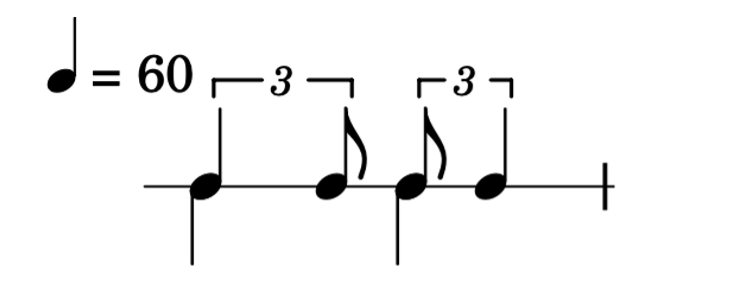
All these values fall well within the range found by London for the perception of a pulse, as the common IOI denominator between the two voices is ~333 ms, or a tempo of 180 bpm. This also means that this polyrhythm can be reduced into the compound rhythm shown in Figure 2, where the eighth note triplet equals 180 bpm.
However, more complex examples and
different metronomic values can very rapidly lead to crossing these cognitive
boundaries. Figure 3 shows a 5:4 polyrhythm with a metronomic value of quarter
note equals 130 bpm. The IOI of the bottom voice is,
60/130 × 1000 = ~462 ms,
and the IOI of the top voice four-fifths of it
is,
4/5 × 60/130 × 1000 = ~369 ms.
The time interval between the second
beat of each voice is equal to the difference between these two values, and the
time interval between the third beat of each voice is twice that last value:
462 ms – 369 ms = 91 ms,
91 × 2 = 182 ms.
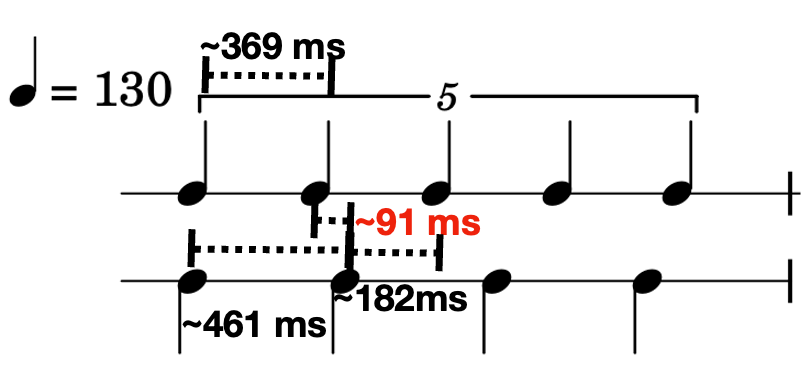

While almost all values are comprised
between 100 and 600 ms, making the relation between
all successive pulses metrical, the time interval of 91 ms
is slightly too short to be interpreted as strictly metrical; therefore, the
second pulse of each voice will rhythmically conflict with each other. As all
polyrhythms are inherently symmetrical, this will also be the case between the
fifth beat of the top voice and the fourth beat of the bottom voice.
The common denominator between the two
voices of Figure 3 is arithmetically the sixteenth note quintuplet (see Figure
4), but because its tempo is out of our cognitive range, the next-slowest
common denominator will be used to perform and mentally represent this
polyrhythm metrically, which is the eighth note quintuplet with an IOI of ~182 ms. This shows that a polyrhythm is not
entirely perceptually metrical or ametrical but that different types of
relations exist between all consecutive pulses of the corresponding compound
rhythm.
This perspective allows many
possibilities for the construction of different polyrhythms that present phases
that are metrical and other phases where metricity is blurred. In that sense,
because the chosen tempo of 130 bpm puts the common denominator of the two
streams just slightly below our perceptual range, the 5:4 polyrhythm of Figure
3 becomes a complex perceptual object presenting both metrical and ametrical phases rather than a strictly rhythmic structure.
As discussed earlier, a performer aiming to interpret Figure 3 as
accurately as possible may encounter challenges if they attempt to deconstruct
the rhythmic structure by finding a common denominator between the two parts.
One alternative strategy frequently used by performers is to re-notate complex
rhythms in a way that remains as perceptually faithful to the original as
possible while facilitating the cognitive processing and interpretation of the
music. In the case of Figure 3, a performer might begin by identifying the common denominator between the two streams, resulting
in Figure 4. However, upon realizing that the IOIs between the second beat of each voice are too short to be performed
metrically, as well as between the fourth and fifth beats, the performer could then re-notate the metrically conflicting notes in one of the
voices as grace notes, while preserving the onsets that are metrically feasible. One
possible outcome of this re-notation is shown in Figure 5.
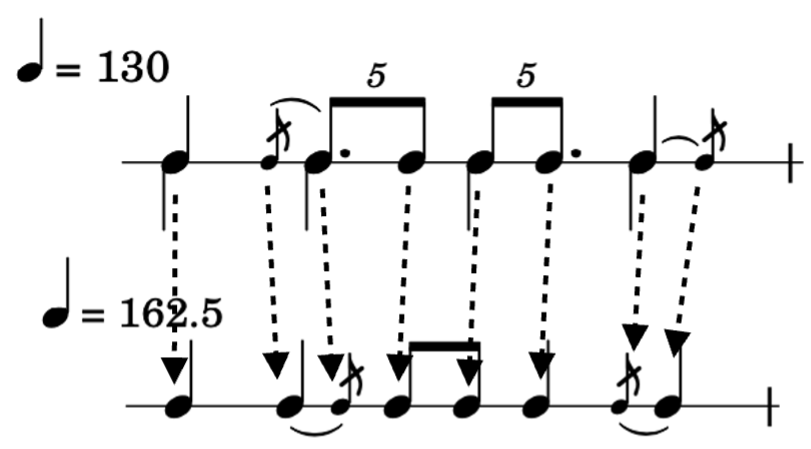
Figure 6 takes this approach further by altering the notated tempo while maintaining the same rhythmic proportions. This adjustment allows the primary voice to be written as quarter notes at 162 bpm, rather than as uneven quintuplets, simplifying the reading process even more.
In his doctoral dissertation on the performance of the music of Györgi Ligeti, pianist Imri Talgam developed a similar re-notation strategy to reduce the cognitive load required to perform multiple polyrhythmic voices simultaneously and maximize the perceptual differentiation between auditory streams (2019). In a subsequent collaborative work on the performance of Xenakis’ highly complex Mists, Talgam and I developed a perceptual grid (Figure 7) for the reduction of multiple polyrhythmic streams (the grid is partially inspired by representations of similar data found in London (2004); see for example Fig. 2.1, p. 36). Basing our work on his experience as a performer of rhythmically complex music and the data provided by London, we determined a number of perceptual categories for all events occurring inside the 0 to 110 ms IOI range that could allow for more precision than just grace notes before or after. This perceptual grid was used in a prototype of an automated rhythmic reduction algorithm I programmed in the OpenMusic software (Bresson, Agon, and Assayag 2011) developed at IRCAM.

In his essay Le feuilleté
du tempo, French composer and music theorist François Nicolas defined a
metric modulation as “a change of tempo and meter achieved through a pivot on a
stable unit of duration” (1990). Perhaps the composer the most
well-known for his use of metric modulations is Elliott Carter, up to the point
where we sometimes hear the term modulation “à la Carter.” Nicolas also proposed
an original and very comprehensive description of metric modulations, which he
presents as multi-layered processes rather than simple tempo equivalence. Even
though he gives them the names impulse, pulse, and measure, the
multiple layers Nicolas uses to produce his model of meter is reminiscent of
the prolatio, tempo, and modus
used by Middle Age and Renaissance composers and seem to indicate a certain
filiation between the temporal conceptions developed in the second half of the XXth century and those of the late Middle Age. I have used
Nicolas’s model for metric modulation for the programming of a few functions in
OpenMusic, and it has also served as the
starting point for the development of my concept of decentralized modulations.
Computer-assisted Composition
In order to assist in the cognitively-informed manipulation of complex polyrhythms and
metric modulations, I have developed a library of tools for the computer-aided
composition software OpenMusic. I will present
two that I find most useful for my compositional works.
1. Calculation of all metrically related
rhythms at a given tempo
Given a certain metronomic value and a rhythmic figure, the first tool allows the calculation of all possible metrically related rhythms that fall within a certain speed range in beats per minute (bpm). Using a minimum tempo limit of 30 bpm and a maximum of 600 bpm makes the range correspond to the cognitive boundaries found by London. However, if for any compositional reason I feel the need to restrain that range further, I only have to change one number in the patch. These reasons usually have to do with musical context: a 600 bpm pulse train may be realistic to perform or perceive accurately as a metric rhythm in laboratory conditions or in the case of instruments that “speak” very fast—such as some percussions or piano —but the attack of bowed string instruments, for example, is so slow that the sound barely has the time to come out and the second pulse is already gone. Asking performers to play intricate compound rhythms at that speed, therefore, seems unreasonable and of little perceptual use.
For that reason, I often use IOI
values between 125 and 1500 ms. 125 ms corresponds to a thirty-second note at 60 bpm, which is an
ample range for polyrhythmic structures. It does not mean that I would never
use any faster values in my music, but I believe it to be more than enough for
the elaboration of a perceivable metric grid. As for the slower boundary,
pulses can theoretically be perceived at tempi down to 30 bpm (or 2000 IOI), but I personally find 40 bpm to be a reasonable,
usable limit. Not all metronomes go below that range, and in my experience,
performers tend to count in subdivisions anyway if the music is written with a
very slow metronome mark.
There are three inputs to the patch
shown in Figure 8: the tempo, in bpm, of the initial rhythmic stream, and the start
and end of the IOI boundaries. Some results at the bottom of the patch are
reproduced in Table 1 in the appendix.
The tool comprises a series of smaller
functions that can be organized into three categories. The first one generates
a list of ratios to be used, with each ratio corresponding to a certain
subdivision in relation to the given initial tempo. The second category is a
series of filters that remove certain subdivisions if they fall out of the
given cognitive boundaries. The third category allows the sorting of
subdivisions according to their corresponding IOI or tempo bpm and the grouping
of subdivisions that share a common denominator.
I can either decide to use a list of
arbitrary numbers or calculate the maximum subdivision the given tempo allows, taking into account the limits I determined. For example, if
I want a section to only use quintuplets and septuplets but not triplets or
sixteenth notes, I can make a list with the corresponding ratios and input it
into the next filtering function. I often prefer to calculate all possibilities
first and then filter at a later stage, as I feel that it allows me to consider
possibilities I wouldn’t necessarily have thought of in the first place.
The function max-sub takes the
initial tempo of a quarter note and a maximum tempo limit as inputs and returns
the fastest subdivision of the quarter note below the maximum tempo. In the
case of 60 bpm and a minimum IOI of 125 ms (480 bpm),
the function returns 8, or an eighth of a quarter note, equivalent to a
thirty-second note,

A second version of max-sub uses
a subdivision of the whole note instead of the quarter note and outputs 32 as
an upper limit for a tempo of 60 bpm. This produces a much greater number of
subdivisions, as any equal division of the whole note can serve as a first
division instead of just the quarter note. However, this approach requires an
additional filtering function later on in the process,
which will be described below.
The next function is called gen-ratios and simply produces the two-by-two combinations of all numbers between 1 and the input, in this case 8. The output result is a list of ratios, starting with ratios faster than the initial pulse (1/8, 1/7, 1/5, etc.) all the way until the given pulse (8/8, or 1/1), and then ratios that are slower than the pulse: 8/7, 7/6, 6/5, etc., until 6, 7, and finally 8. This list of over forty ratios will then be filtered according to various constraints related to our cognitive limits.
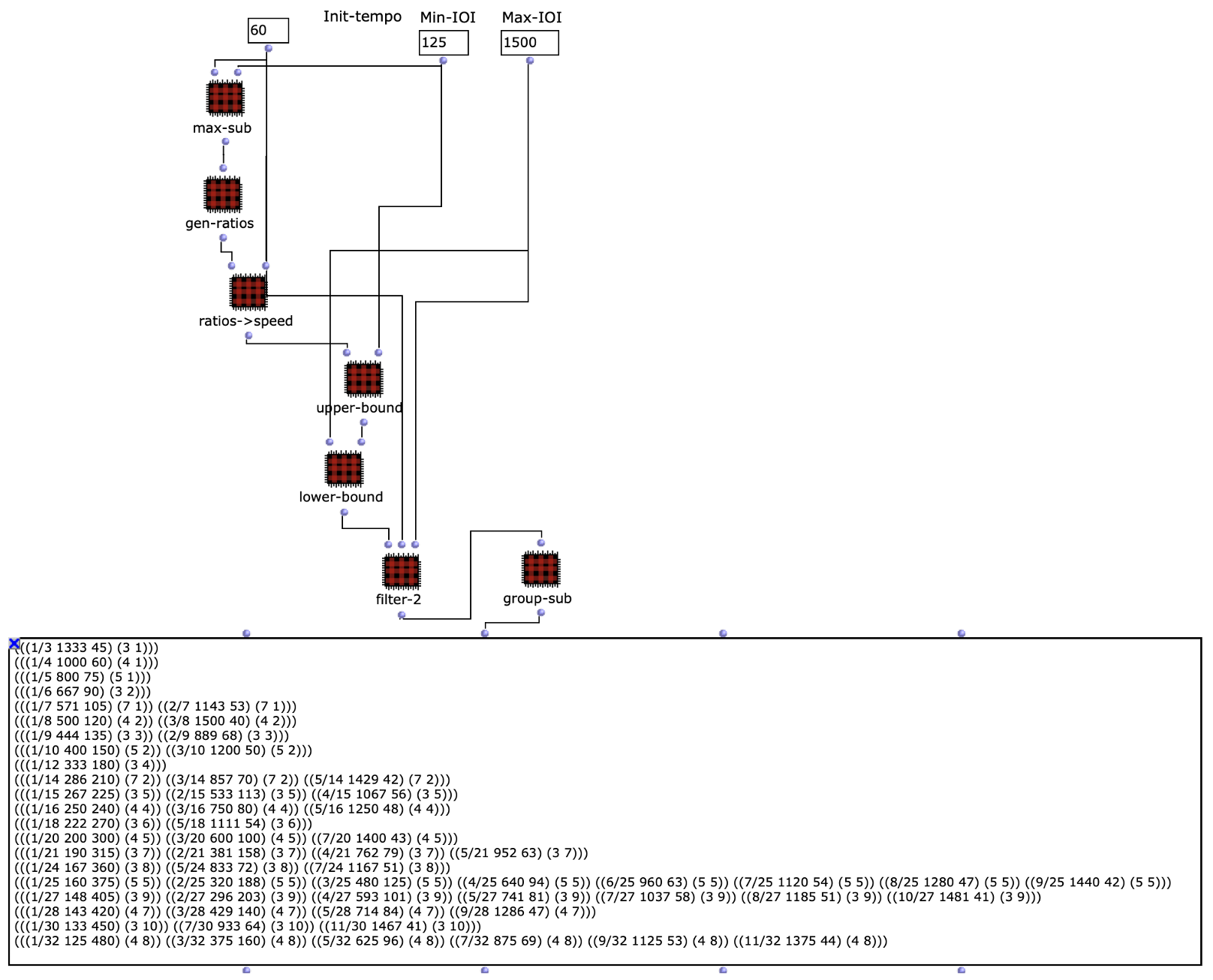
The output of gen-ratio then
goes to the function ratios->speed, which calculates the IOI and
tempo of each subdivision in the given tempo. Since 1/8 means an eighth of a quarter note, we can
divide the initial tempo by that ratio to obtain the frequency of the
subdivision:
60 bpm ÷ 1/8 = 480 bpm => 125 ms IOI
The first value is then multiplied by 1/4 to represent a ratio of a whole note instead
of a quarter note, and the three values (subdivision, tempo in bpm, and IOI in ms) are stored together for each of the inputted
subdivisions. The list of all ratios and corresponding IOIs and tempi then goes
through two functions that remove subdivisions if they are either faster than
the maximum limit determined limit at the given tempo or slower than the
minimum.
If the second version of max-sub has
been used, a third filtering function is required to remove subdivisions that
fall within the given range but require thinking outside of that range
to be performed. For example, the subdivision of 1/31, or 31 equal pulses inside a whole
note, has a tempo of 465 bpm if the quarter note is equal to 60 bpm, which is
lower than my limit of 480 and of the absolute 600 bpm as well. However,
because 31 is a prime number, accurately performing 31 equal pulses at 60 bpm
requires to be able to first have in mind a tempo of 15 bpm, or the whole note,
and then subdivide it into 31 equal parts. While this is certainly not
completely impossible, I would rather rely on other, more practical solutions,
at least in the context of a real-world performance by human beings. The case
is very different for 1/32 since it can itself be subdivided into four
equal parts, thus only requiring the performer to subdivide quarter notes at 60
bpm into eight parts each. In other words, the function checks if a certain
subdivision can be achieved through a nested tuplet, the levels of which would
be metrically related to each other.
This is achieved by first finding if
the given subdivision can be grouped into larger values that would allow the
subdivision of a pulse faster than the minimum tempo. In this case, the goal is
to determine whether the subdivision can itself be divided into a certain
number that corresponds to a faster tempo than 1500 ms,
or 40 bpm. Since 31 is a prime number, there is no possibility of re-grouping
this subdivision into an even number of parts that would each have a duration
comprised between 125 and 1500 ms. A test function
called metrically-related calculates if the
ratio has a common denominator subdivision with 1/4 (the quarter note) that is slower than a 125
ms IOI, or 480 bpm.
The final step is to group all the
rhythms that share the same subdivision denominator. For example, all multiples
of 1/6 (a sixteenth note) will be put in the same
list, and so on for all the rhythmic values. The final output of the patch
gives all the rhythms that are metrically related to a quarter note at 60 bpm,
as well as the way to group the subdivisions so that each sub-level is
metrically related as well.
For example, this is the line
concerning the 1/21 subdivision:
(((1/21 190 315) (3 7)) ((2/21 381
158) (3 7)) ((4/21 762 79) (3 7)) ((5/21 952 63) (3 7)))
The first number in the first set of
parentheses gives the rhythm itself in relation to a whole note. The second
number is the corresponding IOI in ms, while the
third number is the tempo in bpm. The last pair of numbers indicates how to
group the subdivision. In this case, the groupings would be three times seven
pulses of 1/21.
2. Production of “Rhythm Lattice”
The second tool presented here allows
the generation and manipulation of what I call a “rhythm lattice.”
Composers interested in just intonation
principles often use lattice diagrams to represent rational pitch-space. Each
node of the graph corresponds to a harmonic ratio, and each movement on the
graph corresponds to an interval expressed as a frequency ratio. I have adapted
this mode of representation, transferring this pitch-space representation into
time-space instead. The ratios used in my lattices still correspond to
frequency relations, but the range is much slower, and the musical rationale becomes
somewhat different. The rhythm lattice represents paths for metric modulations
and polyrhythms that can be constrained, once again, by cognitive boundaries.
The representation was first inspired
by work done in the field of just intonation by composers and theorists such as
Harry Partch, Ben Johnston, and Erv Wilson, but it also intersects with music
theorists Richard Cohn’s “ski-hill graphs” and Justin London’s “metric trees.”
In his article Complex Hemiolas,
Ski-Hill Graphs and Metric Spaces, Cohn introduced a visual tool he called
the ski-hill graph, designed to represent metric spaces (2001). These spaces are more
or less analogous to the definition Lerdahl and Jackendoff
give of a metrical structure: that is, a hierarchical pattern of subdivisions
and groupings of a pulse. The ski-hill graph depicts possible integer
relations between a certain number of subdivisions that together form a metric
space. It shows, for example, that a quarter note can be subdivided into either
two eighth notes or a three eighth notes triplet. At the bottom of the graph, a
unit pulse ties all the subdivisions together. While the ski-hill graph was, to my
knowledge, not specifically designed to illustrate metric modulations, it is a
useful tool to visually show the multiple possible paths between an initial
pulse and a related subdivision. For example, a possible path only made of
integer relations between the initial quarter note pulse with ratio 1:1 and the
quarter note triplet 3:2 would be to first subdivide the initial pulse in an
eighth note triplet, and then group those eighth notes
by two. Another path would be to do the opposite, or make groups of two quarter
notes, and then subdivide them into three equal parts.
In Hearing In Time, London uses
a similar representation but with the addition of cognitive boundaries relative
to the absolute tempi that the subdivisions produce (2004,
39–41 see Fig. 2.2-4). This way,
not only is it possible to see the possible integer relations between pulses
but also their associated tempo, and therefore the potential to be perceived as
a pulse or not.
While my “rhythmic lattice” may appear
somewhat similar visually, it serves a slightly different goal than the
representations described above and can therefore be seen as either a
development or a variation of it.
The first difference is the inclusion of
the graph of other subdivisions than 2 or 3, and therefore of more than two
axes at a time. The addition of axes with higher prime numbers — 5,
7, 11, etc. — allows the representation of more complex metric structures from
outside the pre-twentieth century classical music canon, both temporally and
culturally.
The second difference is somewhat more
structural, as it concerns the goal of the representation itself but also the
difference between rhythm and meter. The “link” between each node of my graph
is not an integer relation but a frequency ratio; therefore, it does not depict
a strictly hierarchical tree structure made of a series of subsequent groupings
of a single initial pulse but rather a number of potential poly-metric spaces, made of a number of pulses whose corresponding
tempi are closely related.
In a certain way, my rhythm lattices
are somewhat of a second-order ski-hill graph, where all the integer relations
forming the metric space are implicit. For example, the lattice does not show
how to get from a quarter note to a quarter note quintuplet, but it indicates
that modulating once to the quarter note triplet and then to the quarter note
quintuplet produces the ratio 15:8 and that the corresponding tempo of that new
pulse will be 112.5 bpm if the initial quarter note was 60 bpm. Each node
itself is expandable into its own metric tree—which is often what happens in
contemporary music. In that sense, the graph is not a representation of
strictly metrical relations but rather of pulse relations. For that reason, the
graph does not show subdivisions or groupings of any pulse, including by 2,
since the operation does not produce a categorically different metric space,
but just a movement inside an existing one. However, a different compositional
approach could adapt the lattice to use 2:1, 3:2, and 5:4 as axes without a problem.
In any case, the rhythm lattice is to
be read in the following way:
The starting point is the middle ratio
1:1, corresponding to a quarter note. Any horizontal axis gives access to
either a modulation to a quarter note triplet (3:2) if going towards the right
or to a dotted quarter note (2:3) if going towards the left. The diagonal axis
that goes from bottom-left to top-right is the 5:4 / 4:5 axis, corresponding to
modulations to the quarter note quintuplet and the quarter note tied to a
sixteenth note, respectively. The other diagonal axis, going from bottom-right
to the top-left, is the compound ratio of the two first ones, or ratios of 5:6
/ 6:5, corresponding to six sixteenth notes of a quintuplet or five sixteenth
notes of a triplet.
This representation allows the design
of metric modulation paths throughout longer sections while keeping the number
of involved tuplets relatively small. This is more or less equivalent to the notion of limit in
just intonation: in this context, ratios are built only from prime numbers
below a certain threshold. For example, in limit 5, only the prime numbers 2, 3,
and 5 are multiplied together to produce more complex ratios. The lattice above
only uses prime numbers 3 and 5 as a modulation to twice or half of the
duration, which constitutes a trivial case of metric modulation.
Trajectories in the network can also
be expressed as an equation, such as,
(5/4)x × (3/2)y,
where x is the number of modulations along the 5:4
axis, and y is the number of modulations along the 3:2 axis. A negative
exponent would be a modulation in the opposite direction, so a series of 4:5 or
2:3 modulations. For example, starting from the 1:1 ratio, the trajectory going
to 25:24 can be expressed as, (5/4)2 × (3/2)-1,
This represents two positive steps on
the 5/4 axis and one negative step on the 3/2 axis. The advantages of generating the lattice
algorithmically are that the values on any axis can be changed to test many
different possibilities and also that it makes it easy
to verify if all the values fall within the 125-480 ms
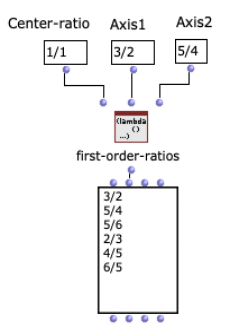
IOI range. Figure 10 shows that, for example,
using 3:2 and 5:4 again as starting ratios, the first-order rhythms—those
connected directly to 1:1—can be generated and are the following ratios: 5:4,
3:2, 6:5, 4:5, 2:3, and 5:6. Then, all of these ratios can themselves be used
recursively in the same function to generate the set of second-order metrically
related ratios. This process corresponds to a secondary metric modulation where
the center of the network becomes these ratios instead of 1:1.
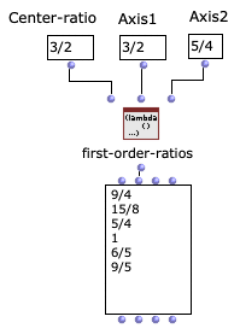
Figure 11 shows the first-order ratios
related to 3/2, which provides the second “web” around this ratio. This process
can be repeated for all first-order ratios in order to
generate the values for the complete lattice shown in Figure 9. Then, the
function metrically-related used in the first
tool presented above can be employed again to find out if any pair of two
values share a common denominator inside the cognitive range and if it is
possible to modulate from one to the other via a common pulse.
In order to represent more than two axes at a
time, a 3D visualization may be produced, each spatial dimension corresponding
to a frequency ratio. Figure 12 gives an example of such a
representation. The axes correspond to ratios 3:2, 5:4, and 7:4 respectively.
Looking at the graph, one can see that starting with the 1:1 ratio at 60
bpm—which could be the quarter note or any other figure—the ratio 6:7, at 51.43
bpm, can be reached by modulating first to the quarter note triplet (one step
towards the right on the red axis) and then to the double-dotted quarter note
(one step down on the blue axis).
Decentralized Metric Modulations,
Notational Innovations, and Musical Examples
Having presented the inspiration that
led me to develop this compositional approach, the cognitive constraints I take into account, and my use of computer-assisted
composition tools, I will now present two concrete musical examples that make
use of alternative notation conventions that I developed and that are partly
inspired by the notational practices of the ars
subtilior. The innovation in this way of notating
rhythm resides in the fact that any performer can start a related polyrhythm at
any given time, regardless of the measure, time signature, etc., allowing for a
complete interdependence of rhythmic voices. I use the word interdependence
instead of independence since my goal is to work with complex yet perceivable
metric relations between different pulse streams, not completely unrelated
pulses. This approach has the advantage of reducing the notated rhythmic
complexity of each individual stream, at least once the system is well
understood by performers.
Example 1: Piece for Quartet (2023)
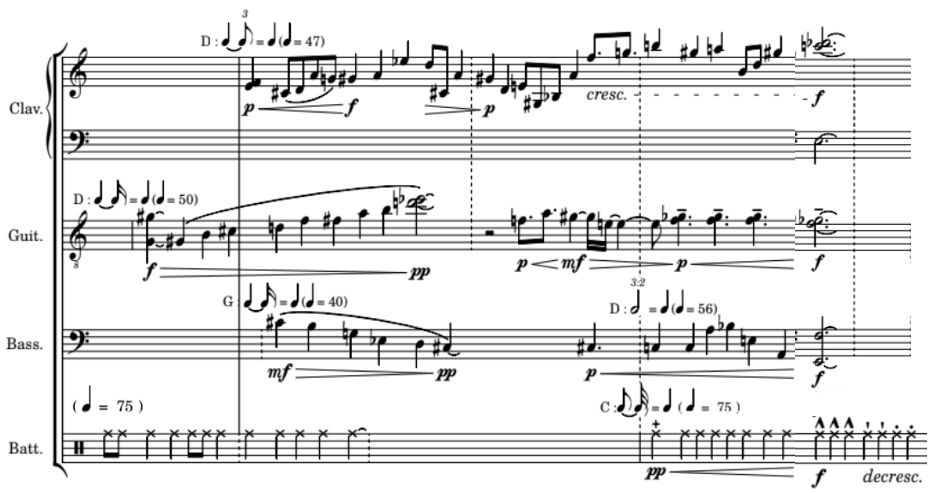
Figure 13 shows a short excerpt of the
first composition where I made use of the idea of decentralized meters and
tempi, for drums, keyboard, electric bass, and electric guitar. The notation
conventions are as follows: - There is no single common meter, so
bar lines are only used to indicate points of simultaneity between two voices. - There is no written time signature, as
all voices are constantly changing meters. - The metronome markings and metric
modulations only apply to the instrument immediately below. For example, the
quarter note tied to a sixteenth note over the guitar part at the beginning of
the staff only applies to the guitar. - The metric modulations always refer to
a tempo previously heard in another voice. The modulation of the guitar is
preceded by a D because the rhythmic figure is in relation to the tempo of the
drums (B for bass, G for guitar, C for keyboard, and D for drums). - Any instrument can start a motive at
any point in relation to any other voice.
- The drums have a tempo of 62.5 bpm
(written in the previous staff). On the second drum beat of the page, the
guitar begins its line by modulating at the quarter note tied to a sixteenth
note, corresponding to 4/5 times the original tempo, or 50 bpm. The resulting
polyrhythm is a 5:4, equivalent to successive quarter notes tied to sixteenth
notes, but the rhythm is written in quarter notes since the metronome mark is
distinct for every instrument. - The keyboard enters on the sixth beat
of the drums (where the line crosses all staves), this time modulating from the
drum’s tempo through the quarter note tied to an eighth note triplet figure, or
3/4 of the initial tempo, corresponding to about 47 bpm. The next modulation
comes from the electric bass, which starts on the fifth beat of the electric
guitar, at a tempo that is 4/5 times slower than that of the guitar, or 40 bpm.
The guitar then plays regular dotted eighth notes in the tempo of the keyboard.
The drums begin a new pulse where the dotted line crosses all staves at a tempo
of 75, or 5/8 of the keyboard’s tempo. The electric bass starts as well, and
after having played one beat in the tempo of the keyboard immediately modulates
to the half note triplet of the drums, giving a tempo of about 56 bpm. Similar
processes continue throughout the whole short piece, instruments coming in and
disappearing, always in rhythms metrically related to a voice that is already
present.
Example 2: Five pieces for string
quartet (written for the Bozzini string quartet, 2023)
The second example comes from my Five
pieces for string quartet, written for the Bozzini Quartet and premiered at
the Fall 2023 Gaudeamus Festival. This piece also makes use
almost entirely of the idea of decentralized meter and tempo, on top of a more
conventional just intonation system for the organization of pitches.
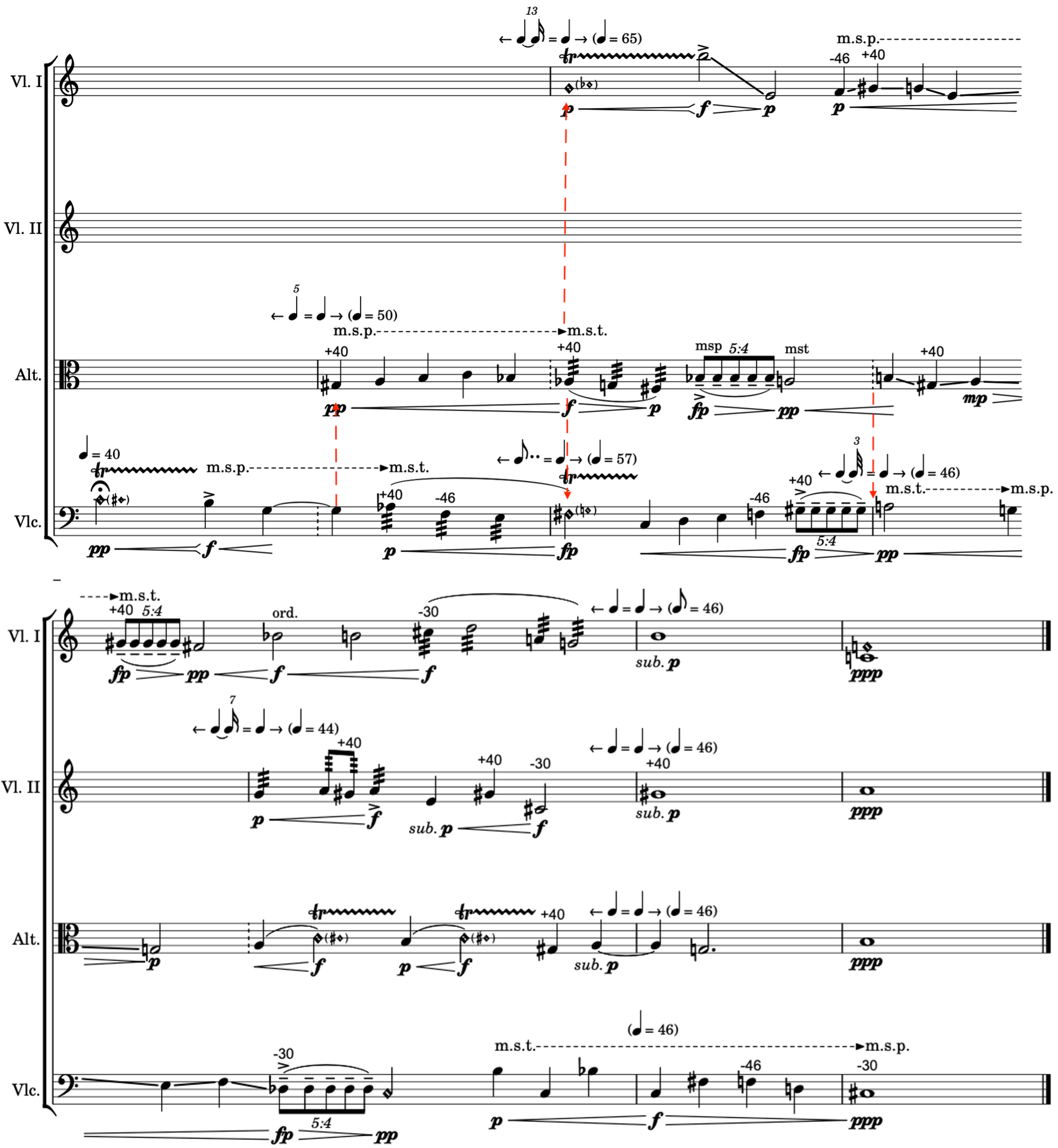
The excerpt shown in Figure 14 is the
fourth piece, which is the shortest of the five. Similar to
the previous example, the cello begins at a tempo of 40 bpm, which serves as a
temporal reference for the following modulations. Here, red arrows are used
instead of letters to indicate which instrument constitutes the reference. The
viola enters on the fifth beat of the cello at a tempo of 50, or 5/4 faster
than the cello. The first violin then enters on the sixth beat of the viola at
a tempo of 65, or 13/10 times faster than 50. At the same moment, the cello
starts playing in a tempo that is 8/7 times that of the viola, or 57 bpm.
Finally, the cello modulates again by taking the viola as a reference, this
time using a 12/13 ratio, giving the metronome mark of 46.
Four of the five pieces were
constructed using this same technique of decentralized metric modulations,
which creates a complex fabric of interweaved pulsations that are all
metrically related. While other parameters such as the amplitude envelope of
each pulse or the proximity of two players may affect the perceptibility of the
polyrhythmic relations, I believe that even the mere structural use of such a
technique allows many possibilities otherwise impossible to write using
conventional notation.
Conclusion The ideas presented in the present
paper are still at a preliminary stage, but they show that structural
complexity does not need to be opposed to perceptibility. On the contrary, many
avenues are still possible for the innovation of the temporal aspect of music
in a way that is not merely abstract but also bears a strong perceptual impact.
Moreover, the growing interest in cognition and understanding how the brain
processes and treats external stimuli as information will surely open other
paths for composers and artists in general who are interested not only in
manipulating abstract structures but also taking into account
how these structures might be perceived by an eventual audience. While a
certain historical response to structuralism and complexity has been to adopt a
more conservative approach through simplifying structures and finding refuge in
more traditional idioms, taking into account
perceptual and cognitive data at the very beginning of the structuring process
opens a third way that has only started to reveal its potential.
References
Apel, Willi. 1946. “The French Secular Music of the Late Fourteenth
Century.” Acta Musicologica 18/19:17–29. https://doi.org/10.2307/932106. ———. 1949. The Notation of Polyphonic Music, 900-1600. 4th
ed. Publication (Mediaeval Academy of America), no. 38. Cambridge: Mediaeval
Academy of America. Bent, Ian D. 1998. “Musical Notation.” In Encyclopedia Britannica. Bolton, Thaddeus L. 1894. “Rhythm.” The American Journal of
Psychology 6 (2): 145–238. https://doi.org/10.2307/1410948. Bresson, Jean, Carlos Agon, and Gérard Assayag. 2011. “OpenMusic:
Visual Programming Environment for Music Composition, Analysis and Research.”
In Proceedings of the 19th ACM International Conference on Multimedia,
743–46. MM ’11. New York, NY, USA: Association for Computing Machinery.
https://doi.org/10.1145/2072298.2072434. Cohn, Richard. 2001. “Complex Hemiolas, Ski-Hill Graphs and Metric
Spaces.” Music Analysis 20 (3): 295–326.
https://doi.org/10.1111/1468-2249.00141. Hirsh, Ira J. 1959. “Auditory Perception of Temporal Order.” Journal
of the Acoustical Society of America 31:759–67.
https://doi.org/10.1121/1.1907782. Lerdahl, Fred, and Ray Jackendoff. 1983. A Generative Theory of
Tonal Music. The MIT Press Series on Cognitive Theory and Mental
Representation. Cambridge, Massachusetts: MIT Press. London, Justin. 2004. Hearing in Time: Psychological Aspects of
Musical Meter. New York: Oxford University Press. Maria, Anna, and Busse Berger. 2002. “The Evolution of Rhythmic
Notation.” In The Cambridge History of Western Music Theory, edited by
Thomas Christensen, 628–56. The Cambridge History of Music. Cambridge:
Cambridge University Press. https://doi.org/10.1017/CHOL9780521623711.022. Monahan, Caroline B., and Ira J. Hirsh. 1990. “Studies in Auditory
Timing: 2. Rhythm Patterns.” Perception & Psychophysics 47 (3): 227–42.
https://doi.org/10.3758/BF03204998. Nicolas, François. 1990. “Le
Feuilleté Du Tempo (Essai Sur Les
Modulations Métriques).” Entretemps 9:51–77. Repp, Bruno H. 2005. “Sensorimotor Synchronization: A Review of the
Tapping Literature.” Psychonomic Bulletin & Review 12 (6): 969–92.
https://doi.org/10.3758/BF03206433. Talgam, Imri. 2019. “Performing Rhythmic Dissonance in Ligeti’s
Études, Book 1: A Perception-Driven Approach and Re-Notation.” City University
of New York. https://academicworks.cuny.edu/gc_etds/3492. Taruskin, Richard. 2009. The Earliest Notations to the Sixteenth
Century. Vol. 1. 5 vols. The Oxford History of Western Music. Oxford
University Press.
Appendix I: Table of all metrically related rhythms for quarter note
= 60 bpm