
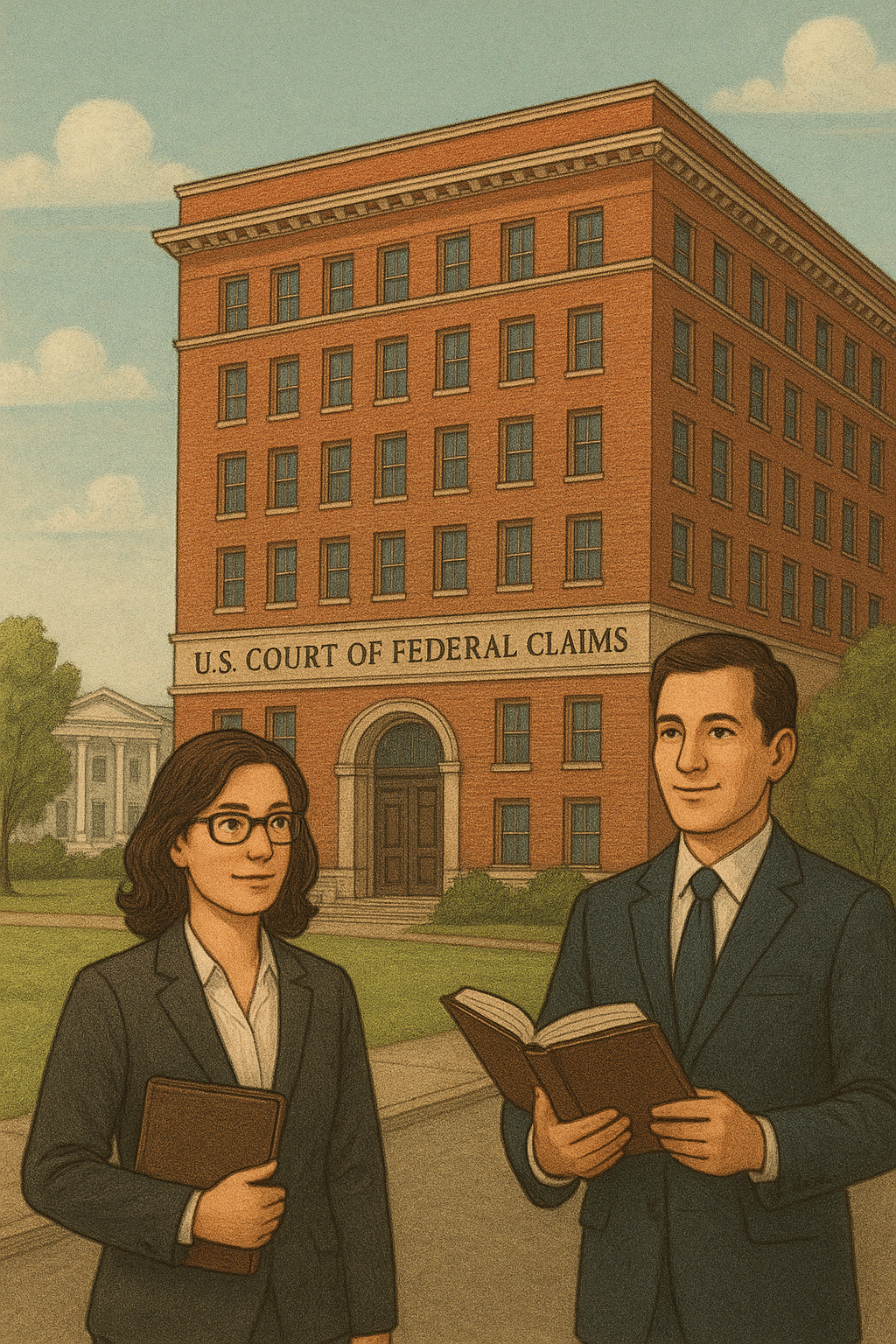
Near the White House stands a tall brick building, containing the chambers of two courts – the U.S. Court of Federal Claims and the U.S. Court of Appeals for the Federal Circuit. While scientist-lawyers typically flock to the Federal Circuit for clerkships, the Court of Federal Claims deserves equal attention. With jurisdiction over intellectual property claims, vaccine injury disputes, and federal contract litigation, the Court of Federal Claims is the perfect clerkship for scientist-lawyers with backgrounds in patent law, public health, and government-funded research.
The Court of Federal Claims can “render judgment upon any [monetary] claim against the United States” over $10,000, including intellectual property infringement by the federal government. While the Court of Federal Claims hears fewer patent cases than the Federal Circuit, it offers trial rather than appellate experience, providing unparalleled training in each phase of a patent lawsuit, from Markman hearings to damages calculations. Furthermore, while other federal trial courts hear a greater number of patent disputes, the Court of Federal Claims’ non-patent docket provides greater exposure to other kinds of scientifically-oriented litigation. Thus, by clerking on the Court of Federal Claims, aspiring patent attorneys can sharpen their patent litigation skills while simultaneously exploring other branches of science and technology law.
The Court of Federal Claims also plays an important role in public health through its supervision of the National Vaccine Injury Compensation Program (VICP). This program was enacted by Congress to compensate patients who suffer severe side effects after vaccination, eliminating the need for expensive litigation in ordinary trial courts. The Court of Federal Claims manages the VICP through its Special Masters, who weigh the evidence of side effects and calculate the appropriate level of monetary compensation. The Court also exercises appellate authority over the VICP, reviewing the Special Masters’ decisions upon petition. Therefore, as a key player in vaccine law, the Court of Federal Claims offers unique opportunities for lawyers with backgrounds in medicine and public health.
The Court of Federal Claims also oversees federal contracting disputes (known as “bid protests”) that arise between government agencies and contractors during the procurement process. A significant amount of research, especially in the military and aerospace fields, is funded through federal contracts, and many “bid protests” involve scientific or engineering subject matter, as exemplified by recent lawsuits involving lunar landers and missile defense technologies. Hence, lawyers with dual interests in scientific and commercial law would gain significant experience in both of these fields during a Court of Federal Claims clerkship.
Scientist-lawyers’ unique skillset is a perfect match for the Court of Federal Claims’ docket, which ranges from patent lawsuits and vaccine injury disputes to government contracting litigation. Law students with technical training should thus seriously consider clerking or externing on this court, commencing their legal careers with full immersion in its science-focused cases. Altogether, while the Court of Federal Claims may not be as familiar as the Federal Circuit, it warrants renewed attention by scientist-lawyers, as it offers valuable opportunities to those seeking to merge the realms of science and the law.