
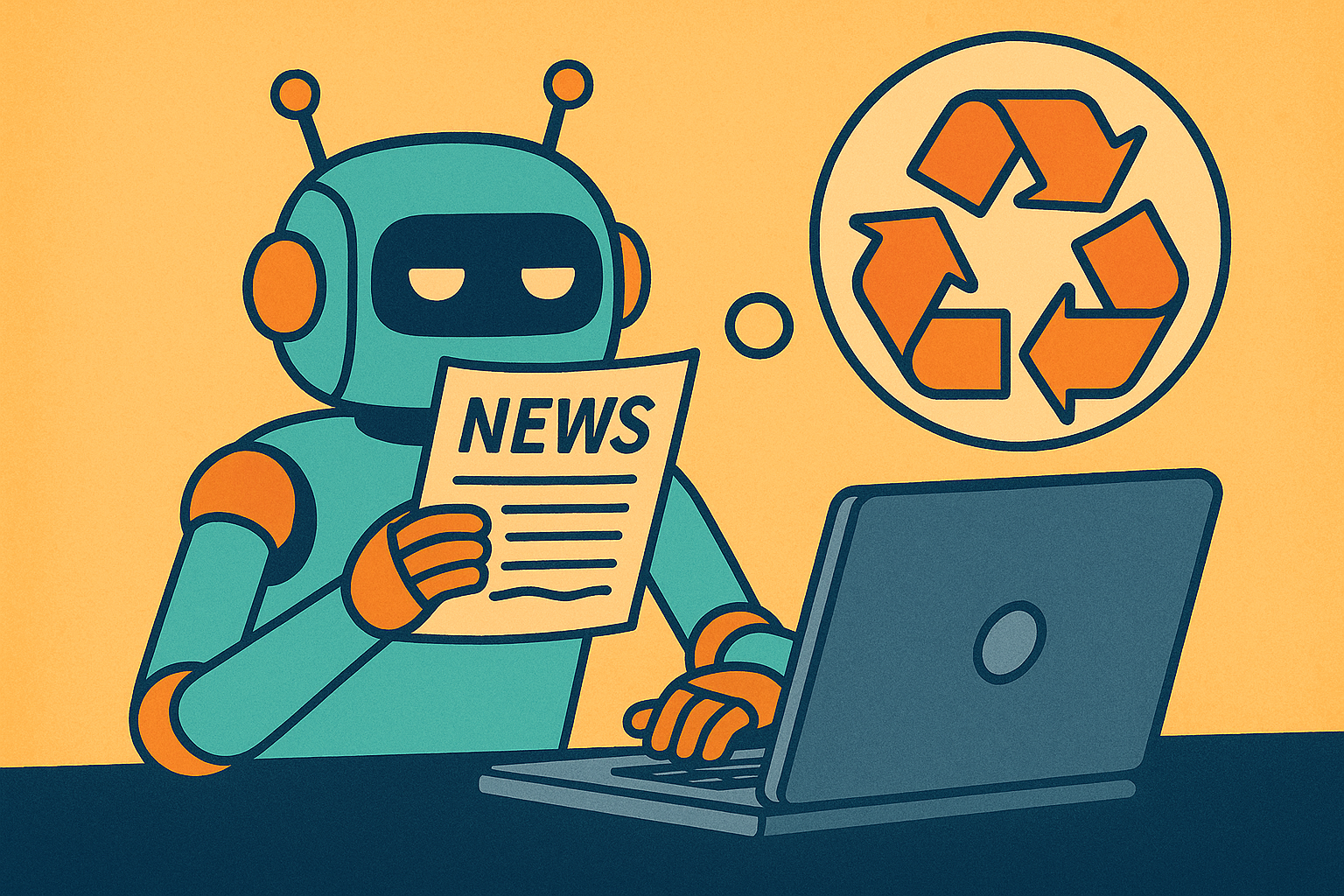
What happens when a machine starts believing its own lies?
Generative AI was built to mirror the internet: to absorb human knowledge and spit it back. But as synthetic text, images, and videos flood the web, these models are now learning from their own creations. The result is a fake-news feedback loop, where misinformation doesn’t just spread: it multiplies.
When AI Eats Its Own Data
It’s a strangely circular process. An AI system writes a convincing story about a fake event. The post goes viral. It gets scraped into a massive training dataset. Then the next model learns from it. The system consumes its own hallucinations treating fiction as fact. Over time, these hallucinations become part of the record and are reinforced once the process begins anew.
Researchers have shown how easily this happens. In one experiment, scientists fine-tuned language models on AI-generated text. The model gained confidence, but also gained errors. Another study in the Harvard Misinformation Review noted that AI hallucinations differ from human lies: they have no intent, which makes them harder to detect or correct. As a result, not only does the algorithmic echo produce more errors but it also masks these errors.
Once these digital fictions circulate they blur the line between truth and fabrication. Fact-checkers just can’t keep up. Web scrapers can’t tell the difference. And users (lawmakers, investors, and even journalists) may not realize when what we’re reading was written by a machine. Again feeding into a strangely circular process.
Europe Draws the Line—America Looks for One
Europe has already moved to contain the loop. Under the new EU Artificial Intelligence Act, data quality isn’t just a best practice—it’s the law. Articles 10 and 13 require high-risk AI systems to train on data that’s “relevant, representative, and error-free,” with clear documentation to prove it. Article 15 goes even further by demanding accuracy and robustness. The Act sends a clear message to AI companies: clean your data or pay up.
By contrast, the United States is still improvising. There’s no comprehensive AI statute. But regulators and lawmakers are beginning to target the same root problem: how and what AI models learn.
1. The FTC: Deception, Impersonation, and Disclosure
The Federal Trade Commission has become the country’s de facto AI watchdog. Using its broad authority over unfair or deceptive practices, the agency implemented a new regulation rule in 2024 targeting deepfake scams and synthetic voices that mimic real people and institutions. A follow-up proposal would extend those protections to private individuals, recognizing that AI’s ability to clone a person’s likeness is no longer science fiction but a consumer harm.
But the FTC’s concerns go deeper than fake faces. The agency has warned that quietly training on AI-generated data could itself be deceptive. If a company claims its model reflects “real-world knowledge” while secretly feeding it synthetic content, that’s a misrepresentation and possibly grounds for enforcement. The FTC now urges firms to document where their training data comes from and disclose when synthetic data is part of the mix.
2. Congress: From Deepfakes to Data Transparency
Congress has long focused on the visible problems such as deepfakes, impersonation, election meddling. For example, the REAL Political Advertisements Act would require political campaigns to clearly label AI-generated content in ads, preventing unlabeled deepfakes from being scraped into tomorrow’s training sets. But a new wave of proposals is starting to address an invisible problem: what happens when the training data itself gets contaminated.
The TRAIN Act (Transparency and Responsibility for AI Networks) would require developers to publicly disclose the sources used to train their models. That means artists, journalists, and researchers could finally see whether their work, or even AI-generated material, was swept into massive datasets. By shining a light on the inputs, the bill aims to give creators more control and allow watchdogs to detect when synthetic content starts feeding back into AI.
This reflects a broader shift in U.S. policymaking. The idea of “data contamination” is only beginning to gain traction, but so far federal efforts are still cast in wider terms. Rather than targeting the quality of training data directly, laws like the Federal Artificial Intelligence Risk Management Act of 2023 focus on overall risk governance: how AI systems are designed, tested, and monitored for safety. It’s a crucial step forward, but one that leaves the question of data integrity largely unresolved.
3. States: The First Responders
While federal policy is still taking shape, states have moved faster. Nearly every state introduced some form of AI legislation in 2025, with California, Texas, and New York leading the way. These laws target the most visible harms such as deepfake election ads, AI-driven impersonation, and nonconsensual sexual content, but their impact reaches deeper. They force disclosure, labeling, or removal of synthetic media, which indirectly tackles the data-quality problem. This makes it less likely that fake or misleading content gets scraped into future training sets.
Breaking the Cycle
Regulators can’t stop AI from generating fiction. But they can stop that fiction from becoming fact. Breaking the fake-news feedback loop will take action on several fronts. Tougher FTC enforcement against deceptive training and impersonation practices, federal transparency and risk-evaluation laws to expose synthetic data, and state-level rules that label or remove AI-generated content before it’s recycled into the next dataset.
These measures won’t eliminate misinformation, but they will slow its self-replication. The goal isn’t to silence machines. It's to make sure they keep learning from the real world, not from the distorted mirror they’ve built. If left unchecked, the feedback loop could not only erode journalism and public trust, but also blur the boundaries of truth. The challenge ahead is simple to describe but hard to solve: teach machines to know when they’re lying . . . and make sure we still can tell the difference.