
I. Introduction
While the Supreme Court in both Washington v. Glucksberg and Vacco v. Quill found that the right to die was not a constitutional right, states like Oregon have chosen to legalize assisted suicide.[1] Although Oregon has legalized assisted suicide, the state does not provide a standard drug regimen. Thus, physicians prescribe an array of drug combinations, which could include a combination of diazepam, digoxin, morphine sulfate, and amitriptyline.[2] While each of these drugs is FDA-approved, the FDA has approved neither the individual drug nor the combination for death.
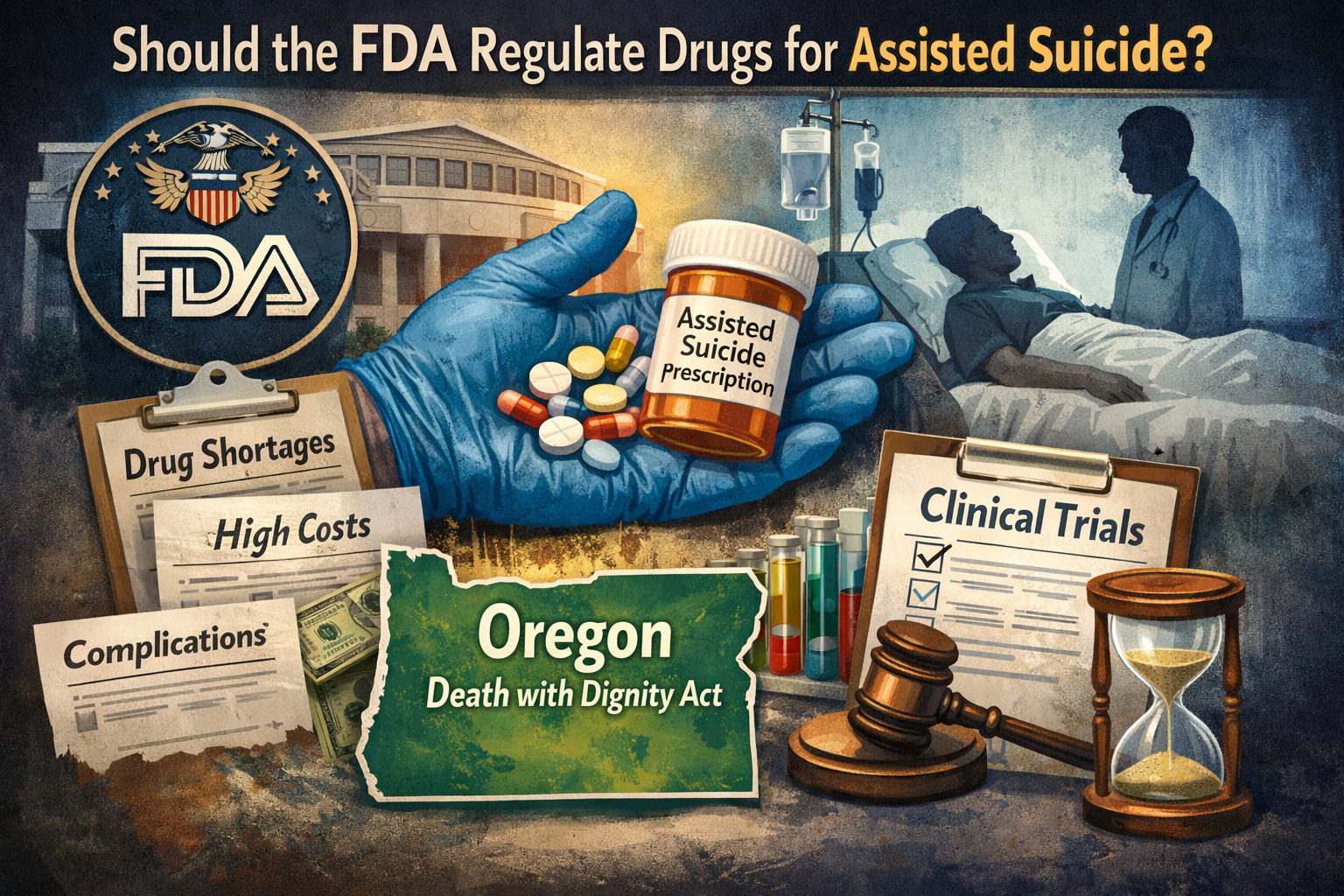
Several problems have emerged due to a lack of FDA oversight on drugs for assisted suicide, including drug shortages, high cost, and side effects. While barriers exist to the FDA having oversight of medications for assisted suicide, solutions may exist to overcome such barriers. These hurdles can be potentially overcome with changes to clinical trial designs. Therefore, the FDA should have a role in regulating drugs for assisted suicide.
II. Problems of FDA Not Regulating Medications for Assisted Suicide
Because there are no drugs that are FDA-approved for assisted suicide, several problems have emerged. One issue is that patients have difficulty obtaining access to medications. In 2014, pentobarbital, which was considered to be the optimal drug for assisted suicide, became unavailable for patients in Oregon.[3] The shortage occurred because the manufacturer for pentobarbital made the policy choice to not ship it to the United States due to the drug’s use in death penalty cases.[4]
Patients also risk complications from a non-standard regimen. Because there is not a drug regimen that is recommended by the FDA, physicians have utilized different drug combinations over a span of eight years in Oregon. The different drug combinations from 2015 to 2022 signal a trial-and-error pattern utilized by physicians. The lack of a standard regimen likely results from an absence of studies that physicians can rely on, and the FDA having oversight of assisted suicide would allow national uniformity, as each physician would be prescribing a consistent regimen based on clinical trials. A standard regimen would also hopefully mitigate complications associated with physician-assisted suicide. Between 2010 and 2022, 11% of patients in Oregon who took drugs for assisted suicide reported suffering from complications.[5] These side effects that are associated with drugs currently prescribed by physicians range from having seizure episodes, regaining consciousness, and regurgitation.
III. Problems of Regulating Medications
There are several barriers that may result from the FDA regulating drugs for assisted suicide. Due to the negative press associated with drugs having intended use for death, pharmaceutical manufacturers may be hesitant to market drugs for assisted suicide. In 2011, Hospira made an announcement that it would no longer resume production of Pentothal, or sodium thiopental, because the company did not condone use of the drug for capital punishment.[6] While an argument could be made that executions are different than assisted suicide, manufacturers may still be hesitant to market a drug for physician-assisted suicide given the close association between the two. As manufacturers have withdrawn medications for capital punishment, they would likely also be hesitant to manufacture drugs for physician-assisted suicide.
In addition to potential negative press, manufacturers would have difficulty in designing clinical trials for drugs utilized for death. In each phase of clinical trials, manufacturers would encounter barriers. It would be unethical to conduct a preclinical safety study in animals, as animals are unable to consent to dying. A challenge exists for Phase I studies as well, because these studies are usually done in healthy volunteers, and it would be unethical to administer drugs for assisted suicide to healthy patients.[7] While an exception could be made to Phase I studies so that drugs for assisted suicide only are provided to terminally ill patients, even recruiting patients may be difficult, considering that in 2023, only 560 individuals received prescriptions in Oregon under the Death with Dignity Act.[8] The number of patients who ingested the medications is even lower, with 367 individuals.[9] Although Oregon is only one of twelve jurisdictions that have legalized physician-assisted suicide, the number of patients who undergo physician-assisted suicide is low nationwide. Less than 1% of people die in each jurisdiction from physician-assisted suicide.[10] Deciding what clinical endpoint to evaluate as part of the clinical trial would also be a challenge. Unlike normal clinical trials that utilize therapeutic improvement as a clinical endpoint, a drug indicated for death would be measured based upon how effectively it kills someone and may present an ethical challenge.
IV. Solutions to the Existing Regime
There are several ways to improve the status quo as well as to tackle the problems that may result from the FDA regulating medications for assisted suicide. A Risk Evaluation and Mitigation Strategy (REMS) program can be implemented to ensure that the drug is being prescribed in a manner that is compliant with state law. For example, isotretinoin, a drug for acne, has teratogenic effects that can cause congenital disabilities when pregnant women take the drug.[11] To ensure that the drug is not accidentally dispensed to a pregnant woman, isotretinoin has a REMS program in which a negative pregnancy test is required before the drug can be dispensed.[12] The FDA could implement a similar program to ensure that only patients with terminal illness who have at most six months to live receive drugs for assisted suicide. While a REMS program is typically implemented to ensure safety for the patients who are taking the drugs, this program may differ in purpose by ensuring that drugs for assisted suicide are not accidentally dispensed to healthy patients.
Challenges to clinical trial design may be overcome in multiple ways. While preclinical animal studies are required to predict safe and non-lethal use in humans, preclinical studies may not be as relevant, given that the intended use here is lethal. In addition, even if animal studies are conducted, these studies would not be more unethical than preclinical studies for other indications. For example, mice are usually used for one experiment and are euthanized at the end of the experiment.[13] In addition, animals are often injected with viruses to study how they react to drugs.[14] In comparison, preclinical studies for drugs for physician-assisted suicide may actually be more ethical in that there would not be a need to purposefully infect animals.
There are several therapeutic endpoints that can be considered as part of the clinical trial design. In determining efficacy of drugs for physician-assisted suicide, patients should be evaluated if they awake after drug ingestion. In Oregon, eight out of 1557 patients woke up after drug ingestion.[15] A new drug for physician-assisted suicide should minimize awakening and be non-inferior to current regimens.
Another endpoint that can be measured is adverse events. As aforementioned, patients can experience complications from existing drug regimens such as vomiting or experiencing seizures.[16] Furthermore, in 2022, 74% of cases in Oregon lacked data on complications, and measuring adverse events would provide further clarity on the side effect profile of medications.[17] Obtaining such endpoints would ensure that patients experience death in a more comfortable manner and as few side effects as possible.
V. Conclusion
States have the authority to decide whether a drug should be approved for suicide or not, and the FDA has remained silent on regulating drugs for suicide. As more states continue to pass legislation to approve physician-assisted suicide, it will be imperative for the FDA to provide oversight in order to provide national uniformity, ensure access to medications, and minimize side effects for patients.
[1] Erika E. Pilver, Oregon Voters Legalize Physician-Assisted Suicide, EBSCO Research Starters (2023), https://www.ebsco.com/research-starters/law/oregon-voters-legalize-physician-assisted-suicide
[2] Regnard et al., Oregon Death with Dignity Act Access: 25-Year Analysis, 0 BMJ Support. & Palliat. Care 1 (2023), https://doi.org/10.1136/spcare-2023-004292.
[3] Nigel Jaquiss, Penalized by the Death Penalty, Willamette Week (May 20, 2014),
http://www.wweek.com/portland/article-22574-penalized-by-the-death-penalty.html.
[4] Id.
[5] Id.
[6] Death Penalty Info. Ctr., Hospira — January 2011 Letter to Clients (Jan. 2011), https://files.deathpenaltyinfo.org/legacy/HospiraJan2011.pdf.
[7] The FDA’s Drug Review Process: Ensuring Drugs Are Safe and Effective, U.S. Food and Drug Administration, https://www.fda.gov/drugs/information-consumers-and-patients-drugs/fdas-drug-review-process-ensuring-drugs-are-safe-and-effective (last visited Feb. 12, 2026).
[8] States Where Aid-in-Dying is Legal, Death with Dignity, Annual Oregon DWD Report Data (Mar. 2024), https://deathwithdignity.org/news/2024/03/annual-oregon-dwd-report-data (last visited Nov. 28, 2025).
[9] Id.
[10] Compassion & Choices, Medical Aid-in-Dying Utilization Report (Jan. 24, 2024), https://www.compassionandchoices.org/wp-content/uploads/2024/02/final_maid-utilization-report_1-24-2024.pdf.
[11] National Academies of Sciences, Engineering, and Medicine, Orphaned but Not Forgotten: Building for the Future (2024), https://www.ncbi.nlm.nih.gov/books/NBK525949.
[12] iPLEDGE Risk Evaluation and Mitigation Strategy (REMS), U.S. Food & Drug Admin., https://www.fda.gov/drugs/postmarket-drug-safety-information-patients-and-providers/ipledge-risk-evaluation-and-mitigation-strategy-rems (last visited Nov. 27, 2025).
[13] Annual Report Laboratory Animals 2020, K.U. Leuven (2020), https://gbiomed.kuleuven.be/english/corefacilities/research-involving-laboratory-animals/annual-report-laboratory-animals-2020-eng/animalexperiments_2020_eng.
[14] Mohammed Habiela et al., Laboratory Animal Models to Study Foot‑and‑Mouth Disease: A Review with Emphasis on Natural and Vaccine‑Induced Immunity, 95 J. Gen. Virol. 2329 (2014), https://pubmed.ncbi.nlm.nih.gov/25000962.
[15] L. Al Rabadi et al., Trends in Medical Aid in Dying in Oregon and Washington, 2(10) JAMA Netw. Open (2019), https://pmc.ncbi.nlm.nih.gov/articles/PMC6692681.
[16] Id.
[17] David Albert Jones, Twenty‑five Years of the ‘Oregon Model’ of Assisted Suicide: The Data Are Not Reassuring, BMJ Med. Ethics Blog (Oct. 27, 2023), https://blogs.bmj.com/medical-ethics/2023/10/27/twenty-five-years-of-the-oregon-model-of-assisted-suicide-the-data-are-not-reassuring (last visited Nov. 26, 2025).