
For decades, “the cloud” functioned as a useful abstraction. It suggested distance, weightlessness, and freedom from physical constraint while implying that data was floating somewhere beyond geography or infrastructure. That abstraction was never fully accurate, but it was close enough for law to treat computation as largely placeless, governed indirectly through contracts, privacy rules, and platform regulation rather than through infrastructure law.
That fiction is becoming harder to maintain. Modern cloud computing depends on large, energy-intensive data centers whose demands increasingly resemble heavy industry. Electricity supply, cooling, land use, and grid access now shape where and how compute can scale. In response, some companies have begun to explore an idea that would once have sounded speculative: placing data centers in space. Orbital compute promises abundant solar energy, passive cooling, and insulation from terrestrial grid constraints. More importantly for legal analysis, it places computation outside the Earth-based regulatory frameworks that currently govern digital infrastructure.
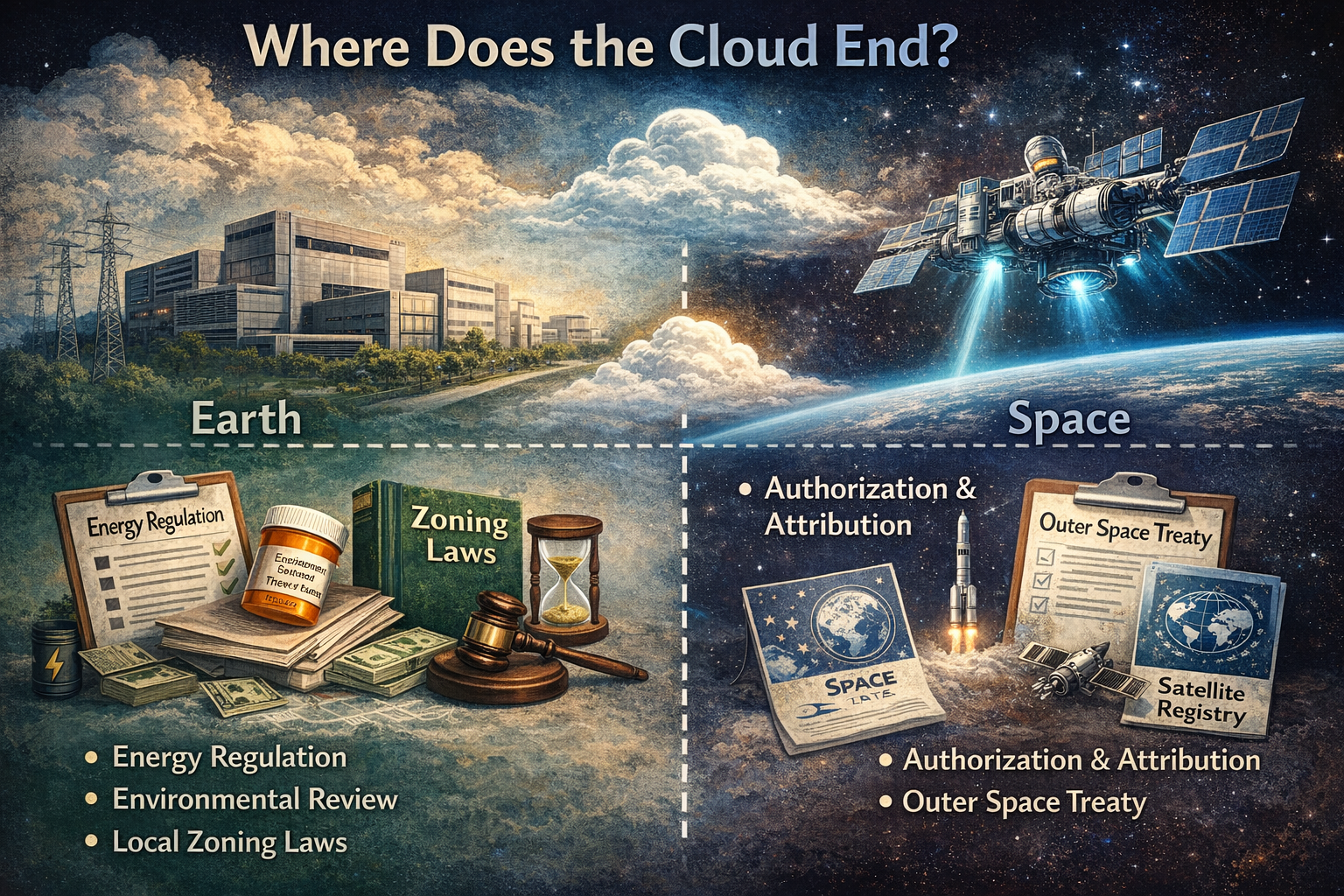
This raises a threshold question that existing doctrine has barely confronted: where does the cloud end? Earth-based data centers are regulated through overlapping regimes of energy law, environmental review, and local land-use controls. Space, by contrast, is governed by a thinner body of law designed for satellites, exploration, and coordination rather than industrial-scale computation. As space-based data centers move from concept toward possibility, compute begins to fall between legal regimes built for different assumptions.
This post maps that boundary. Rather than arguing for or against space-based data centers, it examines how existing space law and terrestrial infrastructure law would apply if computation moves off-planet and what that comparison reveals about how law understands infrastructure.
What Space Law Regulates and What It Leaves Unaddressed
Modern space law developed in a period when space activity was limited, episodic, and closely tied to state power. Its core instrument, the Outer Space Treaty of 1967, establishes principles that continue to structure space governance. The treaty assigns international responsibility to states for national activities in outer space, including those conducted by private entities, and requires states to authorize and supervise such activities.
This framework regulates conduct indirectly. Space law does not license or oversee private actors itself. Instead, states implement the treaty through national authorization regimes and remain internationally liable for damage caused by space objects launched under their authority. Enforcement operates through diplomatic channels and state-to-state responsibility rather than through courts or agencies with continuous supervisory authority.
The substance of space law reflects this structure. Its core rules address national appropriation, weapons in orbit, and liability for damage caused by space objects. Regulation centers on discrete events (including launch, reentry, and collision) rather than on continuous operation. There is no global space regulator, no system of rate-setting, and no doctrine aimed at supervising ongoing industrial activity in orbit.
U.S. implementation follows the same pattern. Commercial space activity is authorized through federal licensing regimes administered by agencies such as the Federal Aviation Administration and the Federal Communications Commission, depending on the activity involved. These regimes evaluate launch safety, collision risk, and interference. Once authorized, ongoing operational oversight is limited.
Recent efforts to elaborate space governance reflect similar priorities. The Artemis Accords develop norms related to exploration, interoperability, safety zones, and resource utilization. Like earlier frameworks, they emphasize coordination and responsibility rather than continuous commercial operation at industrial scale.
Space-based data centers fit uneasily within this structure. As space objects, they would be authorized and attributed to a launching state. Their defining features (continuous computation, persistent energy generation, and long-term operation) do not align with the mechanisms space law uses to regulate activity. Oversight would occur at authorization, while most operational effects would remain legally peripheral.
How Terrestrial Data Centers Are Regulated
On Earth, data centers are regulated as physical infrastructure. Their legal treatment reflects their material characteristics: large buildings, significant electricity demand, extensive cooling requirements, and long-term presence in specific locations. As a result, terrestrial data centers are embedded in layered regimes of energy regulation, environmental review, and local land-use law.
Energy regulation plays the central role. Large data centers are treated as end-use electricity customers subject to utility tariffs, grid interconnection rules, and capacity planning overseen by state public utility commissions and, at the wholesale level, the Federal Energy Regulatory Commission. Utilities plan generation and transmission around projected load, and data centers often figure prominently in those forecasts. Grid upgrades triggered by data center demand are reviewed through established regulatory processes, with costs allocated under rate-setting rules.
Environmental law supplies an additional layer. Data center construction and expansion may trigger review under federal or state statutes when permits, public financing, or federal land are involved. Regulators assess localized impacts such as water use, noise, and emissions, and public processes provide opportunities for participation and challenge. These reviews formalize evaluation of environmental footprint before infrastructure is built.
Local land-use law governs siting and long-term presence. Zoning approvals, building permits, and development agreements embed data centers within municipal planning frameworks. Conditions attached to approval often address infrastructure capacity and community impact. Together, these regimes subject terrestrial data centers to continuous, place-based oversight.
When data centers move to space, much of this regulatory architecture no longer applies. Orbital facilities do not interconnect with terrestrial grids, eliminating utility oversight and rate regulation. Environmental review regimes tied to land use and local emissions lose jurisdictional anchors. Zoning and land-use controls no longer function once infrastructure leaves municipal territory. What remains is authorization and attribution under space law, without the layered mechanisms that govern terrestrial infrastructure over time.
Conclusion
Taken together, space law and terrestrial infrastructure law show that the regulation of large-scale computation has always depended on physical location. On Earth, data centers are governed through legal regimes that attach to place: grid interconnection rules assume a fixed point of electricity demand, environmental review assumes a local footprint, and land-use controls assume a facility situated within a municipal boundary. Space law situates activity differently. It assigns responsibility through authorization and attribution to states, and it governs discrete events associated with space objects rather than the ongoing operation of fixed infrastructure.
The “cloud” has functioned as a rhetorical bridge between these systems. It described computation that appeared distant while remaining anchored in terrestrial locations the law knew how to regulate. That metaphor loses precision when computation itself moves beyond those locations. Space-based data centers operate outside the territorial frameworks that give content to energy, environmental, and land-use regulation.
Seen in this light, asking where the cloud ends identifies the point at which computation is situated differently for regulatory purposes. Existing doctrine suggests that once data centers leave Earth, oversight follows a framework oriented around authorization and responsibility instead of continuous, place-based governance. The cloud ends where location no longer anchors computation within the legal structures that once defined its regulation.