
He doesn’t wear a toolbelt. He doesn’t charge by the hour. He doesn’t unclog your toilet after a Thanksgiving meal. But inside your body, BPC-157 acts as a biochemical plumber, reworking the pipes we call blood vessels, sealing gut damage, and patching up any other damage.
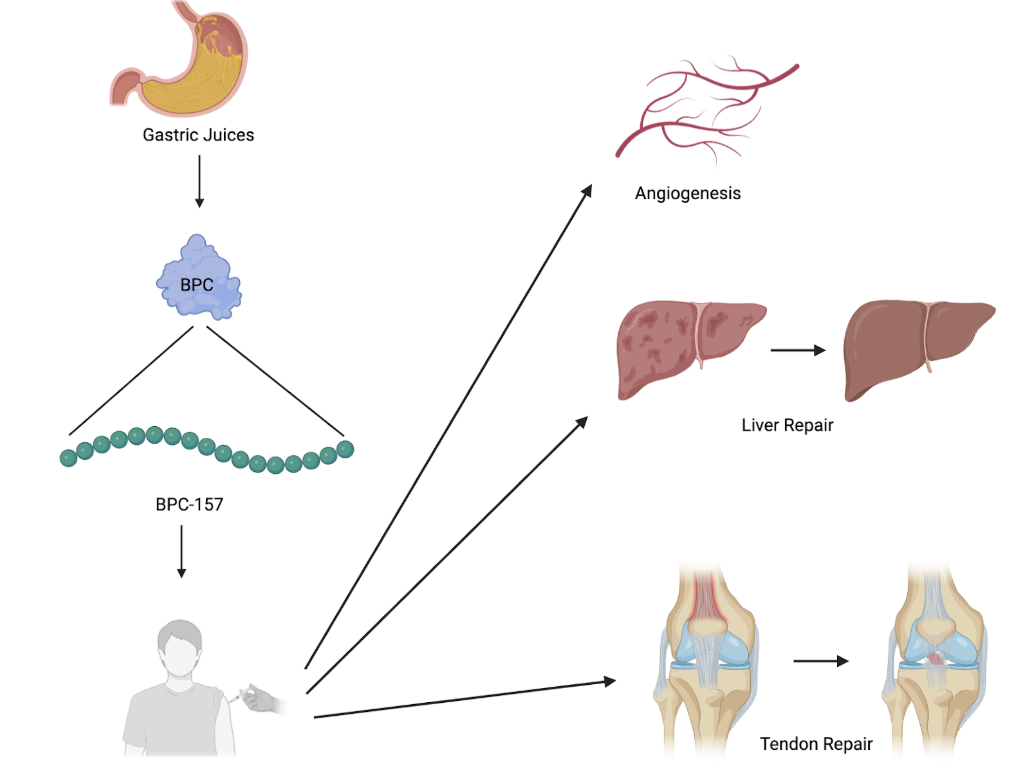
Your body produces the original blueprint for this plumber—the whole protein is called body protection compound (BPC). BPC-157 is a specific 15-amino-acid segment within the blueprint (Xue et al. 2004). While your body can produce the blueprint, we can too in the lab. BPC-157 is only part of the larger BPC peptide and doesn’t occur by itself. We can, however, create this in the lab—like creating a highly specialized contractor trained to fix damage your normal crew can’t handle on their own.
In preclinical rat studies, our biochemical plumber has been shown to lay down new pipes by inducing angiogenesis—the formation of new blood vessels that carry vital nutrients and remove waste (Sikiric et al. 1999). More pipes means more delivery of repair materials, meaning faster wound healing. Just as a plumber installs a new irrigation system after a flood, BPC-157 promotes angiogenesis.
The potential doesn’t stop there; this plumber does more than just pipes. The peptide may also prove to be effective in treating liver damage. In one study, BPC-157 co-injected with other drugs was found to reverse chronic alcohol-induced liver damage in rats (Prkacin et al. 2001). The evidence supports the peptide’s potential as a therapeutic for all types of soft tissue injuries.
Biologically, BPC-157 has been shown to upregulate growth hormone receptors in tendon cells (Chang et al. 2014). This boosted tendon cell proliferation and serves as evidence toward the possibility of this peptide’s healing abilities.
These effects have not gone unnoticed—this plumber’s name has gained a lot of traction in social media and gained a lot of traction on social media. BPC-157 has been nicknamed the “Wolverine peptide” due to its widespread ability to help people recover from injuries in record speeds. People have claimed that it heals joints, fixes gut problems, and even sharpens their minds with minimal side effects. Before you hire this plumber off Craigslist to repair your entire body, be warned. He’s not licensed. Although BPC-157 is backed by research to be a potential therapeutic for many conditions, it is imperative to note that these are only preclinical studies. While these stories sound convincing, the peptide has not passed all required human clinical testing yet. There is an incredibly large leap from anecdotes and rat testing to human applications. Biology becomes more complex, the placebo effect creeps in, and there may even be unintended long-term consequences. Healing is more than just making tissue grow, it’s also doing it in the right place, the right amount, at the right time. This peptide is not FDA approved, and there is no human safety data. Due to the lack of human testing, it is not yet clear whether this peptide may pose a safety risk if taken (U.S. Food and Drug Administration).
When a contractor adds pipes and wiring against regulation, there will always be a risk. BPC-157 increases angiogenesis and growth hormone receptors. These conditions are great for healing, but also great for tumor growth and cancers. Cancer growth can result from unregulated cell proliferation due to genetic or epigenetic mutations. BPC-157 has been shown to increase growth hormone receptor expression in tendon cells thereby boosting repair. However, it is unclear whether this growth could cause cancer or exacerbate existing tumors. Anything that upregulates growth pathways warrants long-term safety evaluation. Because there are no tumor studies in the presence of BPC-157 or long-term human studies, supplemental use should be cautioned. Until more rigorous research and clinical studies have been performed, BPC-157 should not be taken therapeutically.
BPC-157 may just be one of the most promising up and coming plumbers, but until there have been more background checks, validated permits, and supervision of its work in human trials, it’s best to hold off on calling it for any repairs.
References
Center for Drug Evaluation and Research. (n.d.). Substances in compounding that may present significant safety risks. U.S. Food and Drug Administration. https://www.fda.gov/drugs/human-drug-compounding/certain-bulk-drug-substances-use-compounding-may-present-significant-safety-risks
Chang, C.-H., Tsai, W.-C., Hsu, Y.-H., & Pang, J.-H. (2014). Pentadecapeptide BPC 157 enhances the growth hormone receptor expression in tendon fibroblasts. Molecules, 19(11), 19066–19077. https://doi.org/10.3390/molecules191119066
Prkacin, I., Separovic, J., Aralicia, G., Perovic, D., Gjurasin, M., Lovric-Bencic, M., Stancic-Rokotov, D., Staresinic, M., Anic, T., Mikus, D., Sikiric, P., Seiwerth, S., Mise, S., Rotkvic, I., Jagic, V., Rucman, R., Petek, M., Turkovic, B., Marovic, A., … Kokic, N. (2001). Portal hypertension and liver lesions in chronically alcohol drinking rats prevented and reversed by Stable Gastric pentadecapeptide BPC 157 (PL-10, PLD-116), and propranolol, but not ranitidine. Journal of Physiology-Paris, 95(1–6), 315–324. https://doi.org/10.1016/s0928-4257(01)00044-4
Sikiric, P., Šeparovic, J., Anic, T., Buljat, G., Mikus, D., Seiwerth, S., Grabarevic, Z., Stancic-Rokotov, D., Pigac, B., Hanzevacki, M., Marovic, A., Rucman, R., Petek, M., Zoricic, I., Ziger, T., Aralica, G., Konjevoda, P., Prkacin, I., Gjurašin, M., … Rotkvic, I. (1999). The effect of pentadecapeptide BPC 157, H2-blockers, omeprazole and sucralfate on new vessels and new granulation tissue formation. Journal of Physiology-Paris, 93(6), 479–485. https://doi.org/10.1016/s0928-4257(99)00123-0
Xue, X.-C., Wu, Y.-J., Gao, M.-T., Li, W.-G., Zhao, N., Wang, Z.-L., Bao, C.-J., Yan, Z., & Zhang, Y.-Q. (2004). Protective effects of pentadecapeptide BPC 157 on gastric ulcer in rats. World Journal of Gastroenterology, 10(7), 1032. https://doi.org/10.3748/wjg.v10.i7.1032