
Letter from the Editor
Article Sidebar
Main Article Content
Abstract
Dear Reader,
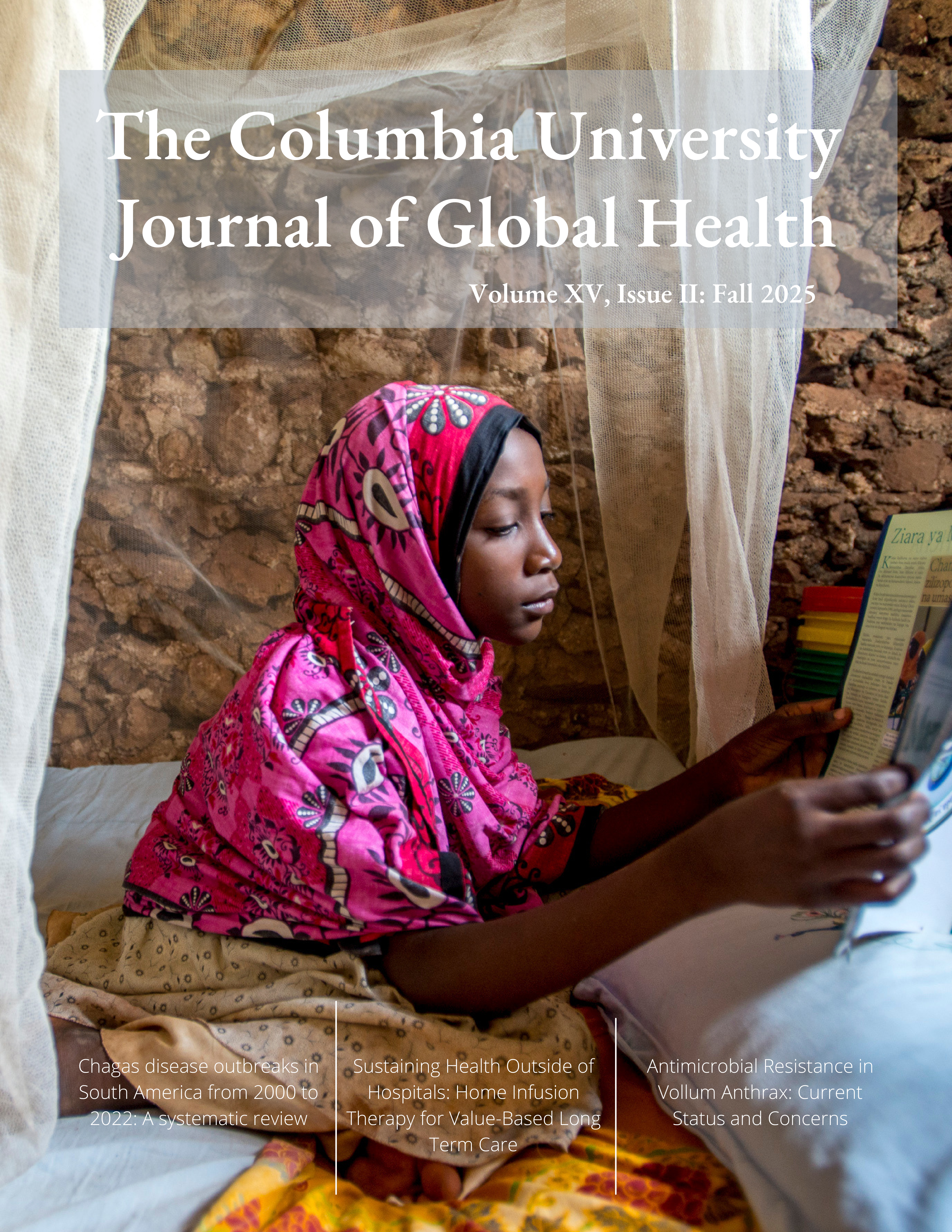
We are proud to introduce The Columbia University Journal of Global Health Fall 2025 issue, The Futures of Global Health Vol. 15. Over the past decade, global health has undergone rapid transformation—driven by breakthroughs ranging from AI-enabled diagnostics to large-scale improvements in health system delivery, including expanded vaccination programs, digital medical records, and decentralized care models. As these advances redefine the present, they also raise critical questions about the future of health systems, innovation, and global equity. This issue is dedicated to examining those questions and imagining the paths forward for global health in an era of unprecedented change.
This edition features compelling research articles that examine the future of global health across diverse geographic and thematic contexts. We are pleased to present “Artificial Intelligence Tools for Diabetic Retinopathy Screening in Low-Resource Environments: Review of Global Implementation and Challenges” by Grace et al., which evaluates the performance, real-world implementation, and context-specific barriers of AI-based diabetic retinopathy screening tools in low- and middle-income countries.
Next, “Determinants of Childhood Immunization Non-Compliance Among Nursing Mothers in a Resource-Constrained Setting, Southwest Nigeria” by Olasupo et al. investigates key barriers to childhood vaccination and proposes strategies to improve immunization uptake in Nigeria. “Sustaining Health Outside of Hospitals: Home Infusion Therapy for Value-Based Long-Term Care” by Graham et al. examines the evolving landscape of home infusion therapy across the United States, Canada, Europe, and Australia, highlighting its role in value-based care models.
In “The Little Country that Could: Creative Solutions to Early COVID-19 Vaccination in the Republic of Moldova,” Cobb et al. analyze innovative pandemic responses and identify lessons applicable to future infectious disease management. Additionally, “Antimicrobial Resistance in Vollum Anthrax: Current Status and Concerns” by Sasson explores emerging antimicrobial resistance patterns in anthrax, underscoring significant public health implications. Finally, “Chagas Disease Outbreaks in South America from 2000 to 2022: A Systematic Review” by Smith synthesizes two decades of outbreak data to inform improved prevention strategies and early detection methods.
Collectively, the research in this issue spans contributions from the United States, Canada, Australia, multiple European countries, Singapore, India, and Nigeria, reflecting the truly global scope of this edition.
Beyond these peer-reviewed research articles, the Journal remains committed to fostering scholarly dialogue in global health. On campus, we were proud to host a BioInnovation Panel on November 13, 2025, featuring Dr. Miranda of Barnard College, Professor of Biological Sciences and a renowned virologist, and Dr. Hess of Columbia Engineering, Professor of Biomedical Engineering and tissue engineer. The discussion highlighted emerging innovations in healthcare technology and their implications for the future of global health. We were pleased to welcome more than 30 attendees to this engaging and interdisciplinary panel.
In addition to our peer-reviewed research, the Journal’s online team continues to expand public-facing engagement through blogs and podcasts that address timely global health issues. This semester’s blog features explore a wide range of topics, including food deserts and fast food industry exploitation in Black communities in New York City, the ways low-income status shapes medical decision-making, housing instability’s role in the growing diabetes crisis, and community-based mental health interventions such as the Friendship Bench. Other pieces examine emerging technologies—such as the brain–computer interfaces—and the global human impact of fast fashion. Through both written and audio formats, the Online Team works to translate complex global health challenges into accessible, compelling narratives for a broader audience. Our commitment to making research as accessible as possible could not have been done without our online team.
The Fall 2025 issue represents a significant milestone for our journal and a moment of celebration for our editorial staff, who stewarded each manuscript from submission through publication. As a double–peer-reviewed journal, we are profoundly grateful to all those who make this publication possible. We extend our sincere thanks to the authors who entrusted us with their rigorous and impactful scholarship, and to the peer reviewers whose thoughtful and incisive feedback strengthened every contribution.
We are grateful to our publisher, Columbia University Library Partners, and especially to our librarian, Esther Jackson, for her unwavering support and guidance throughout the publication process. We also sincerely thank our faculty advisors—Mr. Ron Guido, Dr. Dana March Palmer, PhD, and Dr. Merlin Chowkwanyun, PhD—for their continued mentorship, expertise, and commitment to the Journal’s mission.
Finally, to our readers, thank you. You are an essential part of the Columbia University Journal of Global Health community. We hope this issue offers work that is intellectually engaging, socially relevant, and impactful in advancing global health discourse.
Sincerely,
Rose Liu and Manan Vij
Co-Editors-In-Chief
The Columbia University Journal of Global Health
Article Details

This work is licensed under a Creative Commons Attribution 4.0 International License.