
The “person having ordinary skill in the art” (PHOSITA) is a central figure of patent law and is routinely compared to the “reasonable person” of tort law. This reasonable person is a legal fiction, a hypothetical being for the judiciary to channel societal norms and policy goals through to determine how a real person should act under a specific set of facts. Who the reasonable person is will determine which behavior is socially encouraged or deterred, and arguably plays the most significant role in determining the outcome of tort litigation. Much like tort law, the PHOSITA is another hypothetical person, serving to channel patent doctrine and its policy goals. Who the PHOSITA is and what the PHOSITA knows is essential to determining the validity of a patent and any subsequent infringement. However, unlike tort law, recent legal scholarship suggests the PHOSITA might not be as consequential as one might assume.
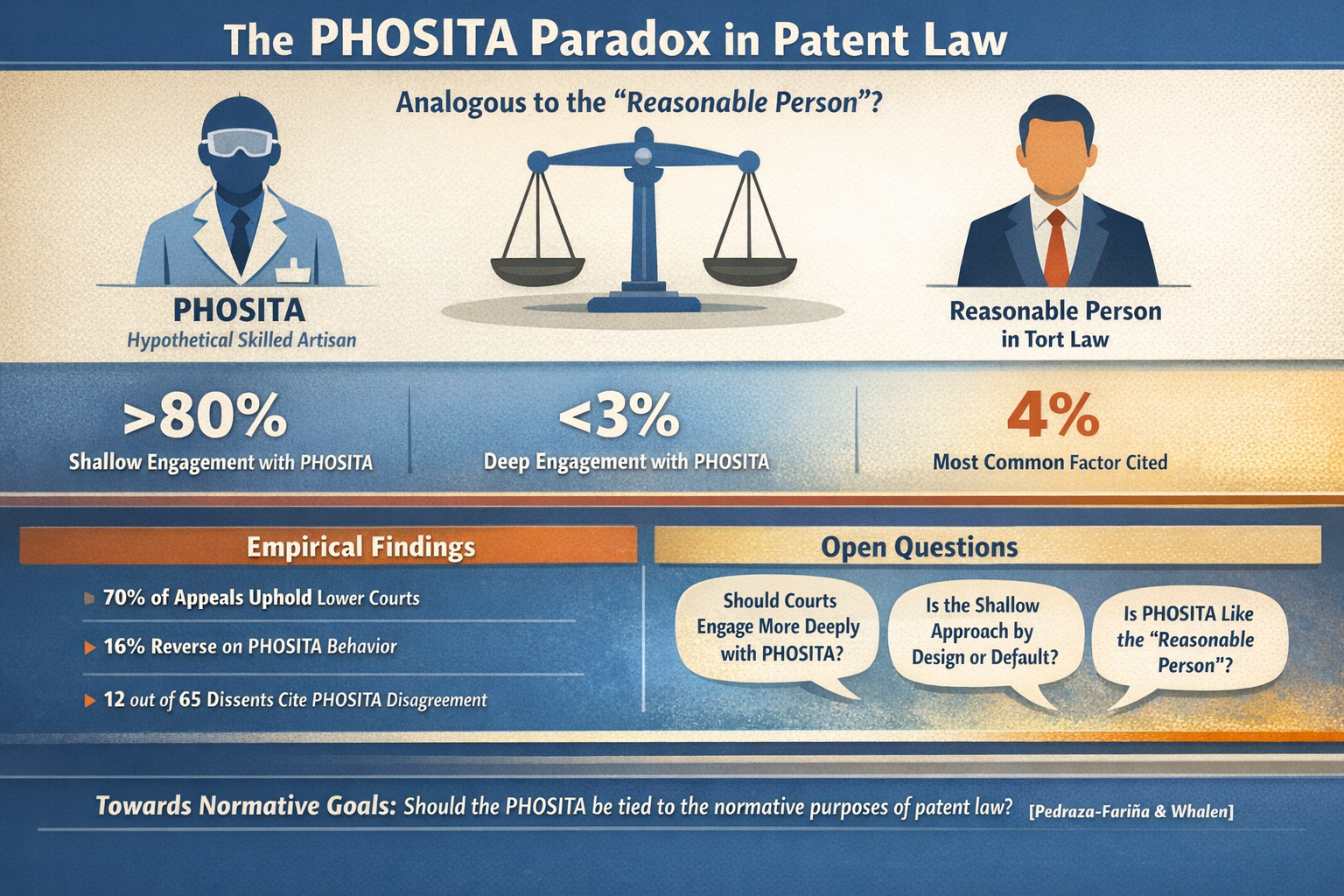
Laura Pedraza-Fariña and Ryan Whalen’s law review article “The Ghost in the Patent System: An Empirical Study of Patent Law’s Elusive ‘Skilled Artisan’” takes the first ever comprehensive empirical study into the role of the PHOSITA.[1] Pulling from over 7000 patent cases, the authors dissect how courts use the PHOSITA in judicial reasoning and conclude this hypothetical person, a core tenet of patent law, is rarely identified and not outcome-determinative to patent disputes.[2] From a randomly sampled subset of 500 cases, Pedraza-Fariña and Whalen found 318[3] of them feature a PHOSITA-related holding: “related factual findings, legal findings, and holdings as to how the PHOSITA would behave.”[4] They then sorted the opinions into three groups of varying judicial engagement with the PHOSITA: shallow, moderate, or deep.[5] Shallow engagement is where judges provide “little-to-no reasoning to support PHOSITA-related holdings;”[6] these are conclusory assertions about what the PHOSITA would do, without defining who the PHOSITA is or how they would approach the subject matter. Moderate engagement provides “some limited reasoning and evidence to support PHOSITA-related holdings;”[7] the PHOSITA is not clearly defined but the court offers some evidence to extrapolate a level of technical comprehension.[8] Deep engagement occurs when judges support “holdings thoroughly with evidence and reasoning that considers what the PHOSITA would know and/or what they would do,”[9] such as when the court determined the PHOSITA to be an individual with a bachelor’s degree in electrical engineering and several years of industry experience.[10] If the PHOSITA really is an analog to the reasonable person in tort law, one might expect courts to engage deeply. However, the mass majority of these cases (>80%) demonstrated shallow engagement with the PHOSITA while less than 3% demonstrated deep engagement,[11] suggesting courts do engage with the PHOSITA concept but rarely ever labor over its identity. To further support this phenomenon, Pedraza-Fariña and Whalen also measure the frequency in which courts cite the objective factors used to identify the PHOSITA. These factors include: “(1) the educational level of the inventor; (2) type of problems encountered in the art; (3) prior art solutions to those problems; (4) rapidity with which innovations are made; (5) sophistication of the technology; and (6) educational level of active workers in the field.”[12] If courts were meaningfully engaging with the PHOSITA in their analysis, one would expect the frequency of any of these factors to be relatively high. However, from the same subset of PHOSITA-related cases as above, the authors find these factors are rarely used: the most common factor is only referenced in approximately 4% of the cases.[13]
Despite this apparent indifference towards the PHOSITA, Pedraza-Fariña and Whalen’s findings suggest this hypothetical person is rarely a source of disagreement in court. From a random subset of 363 appellate cases with PHOSITA-related holdings, approximately 70% upheld the lower court.[14] Appellate cases “only infrequently” reversed for the PHOSITA: 16% reversed due to the expected behavior of the PHOSITA (i.e. whether a PHOSITA would be likely to combine two references), 4.5% reversed on factual findings of the PHOSITA, and less than 1% reversed because the lower court’s finding on who the PHOSITA is was incorrect[15]. Additionally, from the same subset, the authors identified 65 dissents which reference the PHOSITA. From these 65 dissents, only 12 pushed back against the majority for how they set aside the PHOSITA in decision making.[16]
Pedraza-Fariña and Whalen’s findings suggest the PHOSITA is not nearly as consequential in practice as it is in theory. Comparing to the reasonable person, a significant portion of tort law literature posits whether their hypothetical person should serve an empirical or normative function, whereas patent law has remained relatively silent on this distinction. In fact, the authors suggest this uncertainty between the empirical and normative are why courts engage so shallowly with the PHOSITA.[17] That leaves us with certain open questions: Should courts engage more deeply with the PHOSITA? Is this predicament harmful to the practice of patent law, or is it deliberately designed this way? Is it even right to compare the PHOSITA to tort law’s reasonable person? Pedraza-Fariña and Whalen provide their own answer: the PHOSITA construct should be tied to the normative goals of patent law.[18]
[1] Laura Pedraza-Fariña, Ryan Whalen, The Ghost in the Patent System: An Empirical Study of Patent Law's Elusive "Skilled Artisan", 108 Iowa L. Rev. 247 (2022).
[2] Id. at 251.
[3] Id. at 271.
[4] Id. at 265.
[5] Id. at 269.
[6] Id. at 270.
[7] Id.
[8] Id.
[9] Id.
[10] Broadcom Corp. v. Emulex Corp., 732 F.3d 1325, 1334–35 (Fed. Cir. 2013).
[11] Laura Pedraza-Fariña, Ryan Whalen, The Ghost in the Patent System: An Empirical Study of Patent Law's Elusive "Skilled Artisan", 108 Iowa L. Rev. 247, 271 (2022).
[12] Env’t Designs, Ltd. v. Union Oil Co., 713 F.2d 693, 696 (Fed. Cir. 1983).
[13] Laura Pedraza-Fariña, Ryan Whalen, The Ghost in the Patent System: An Empirical Study of Patent Law's Elusive "Skilled Artisan", 108 Iowa L. Rev. 247, 272 (2022).
[14] Id. at 265.
[15] Id. at 265-66.
[16] Id. at 265.
[17] Id. at 278.
[18] Id. at 281.