Nearly three decades after its release, Peter Chan’s Comrades: Almost a Love Story (1996) remains that rarest of achievements: a film that succeeds as both historical document and timeless storytelling. In an era when cinema is increasingly reliant on milquetoast, algorithmically-driven remakes, reboots, and sequels, Chan’s intimate masterwork reminds us why certain films transcend their moment of conception to become permanent reference points in our understanding of love, displacement, and identity. [1]
The film’s genius lies in its deceptive simplicity. On the surface, it tracks the decade-long relationship between Li Xiaojun (Leon Lai), a naïve mainlander who arrives in 1980s Hong Kong to earn enough money to marry his sweetheart back home, and Li Qiao (Maggie Cheung), a no-nonsense city-slicker from Guangzhou who works odd jobs. They meet, separate, reconnect across continents and years—a romantic structure as old as cinema itself.
Released just months before Hong Kong’s 1997 handover to China, Comrades became an accidental elegy for a disappearing world; yet, its prescience extends far beyond that historical moment. Chan was mapping what would become the defining condition of 21st-century life: perpetual migration, fractured identities, and the promise and cost of reinvention. Today, global migration has reached unprecedented levels and millions are learning to navigate between multiple cultural identities. [2] In an increasingly mobile world, the film’s central question—where is home when you've left one place but never quite arrived at another?—resonates with renewed urgency.
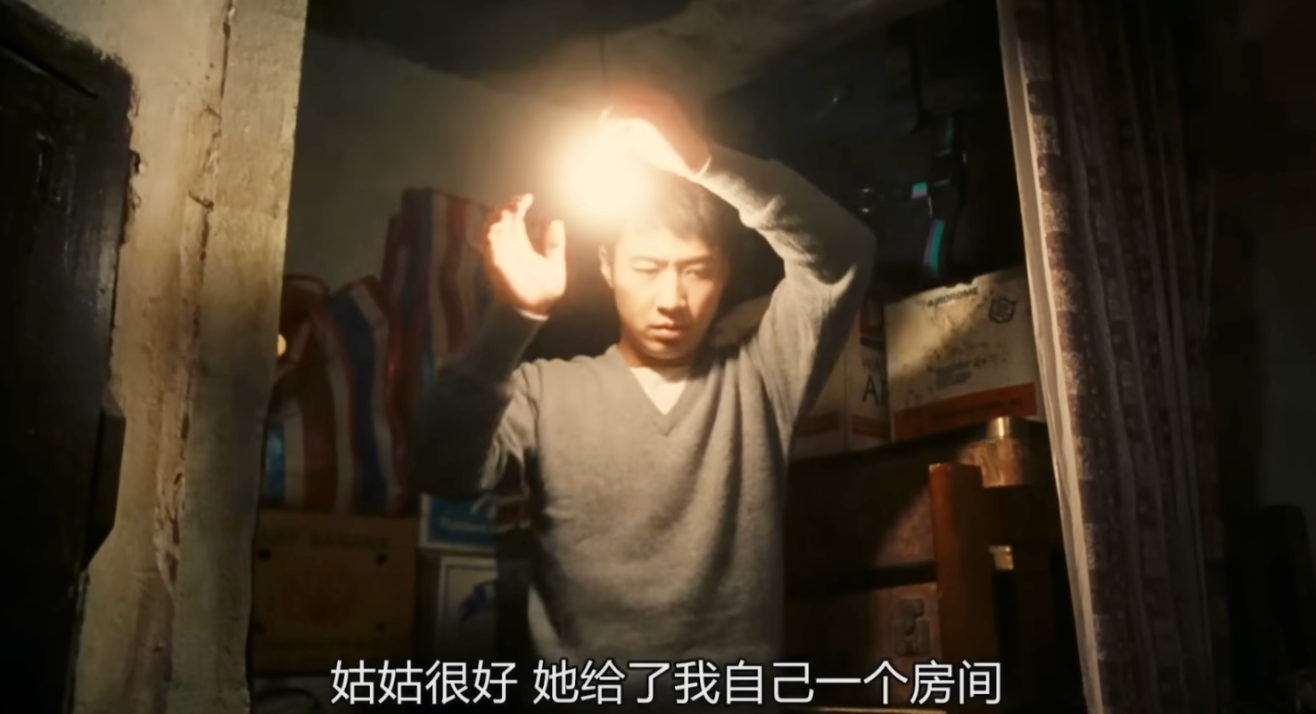
Xiaojun describing his living quarters: “Auntie was very good to me. She gave me my own room.”
The film’s formal intelligence reveals itself in Chan's spatial grammar. Hong Kong, New York—even Xiaojun’s native Tianjin, in which “there is no McDonald’s”—each location functions as an active force shaping the characters’ emotional possibilities. Watch how Chan frames Xiaojun in his cramped Hong Kong quarters (the back room of a brothel his aunt helps run), or places Qiao against the vast indifference of Manhattan: The camera understands that space is never neutral. It either offers refuge or enforces exile.
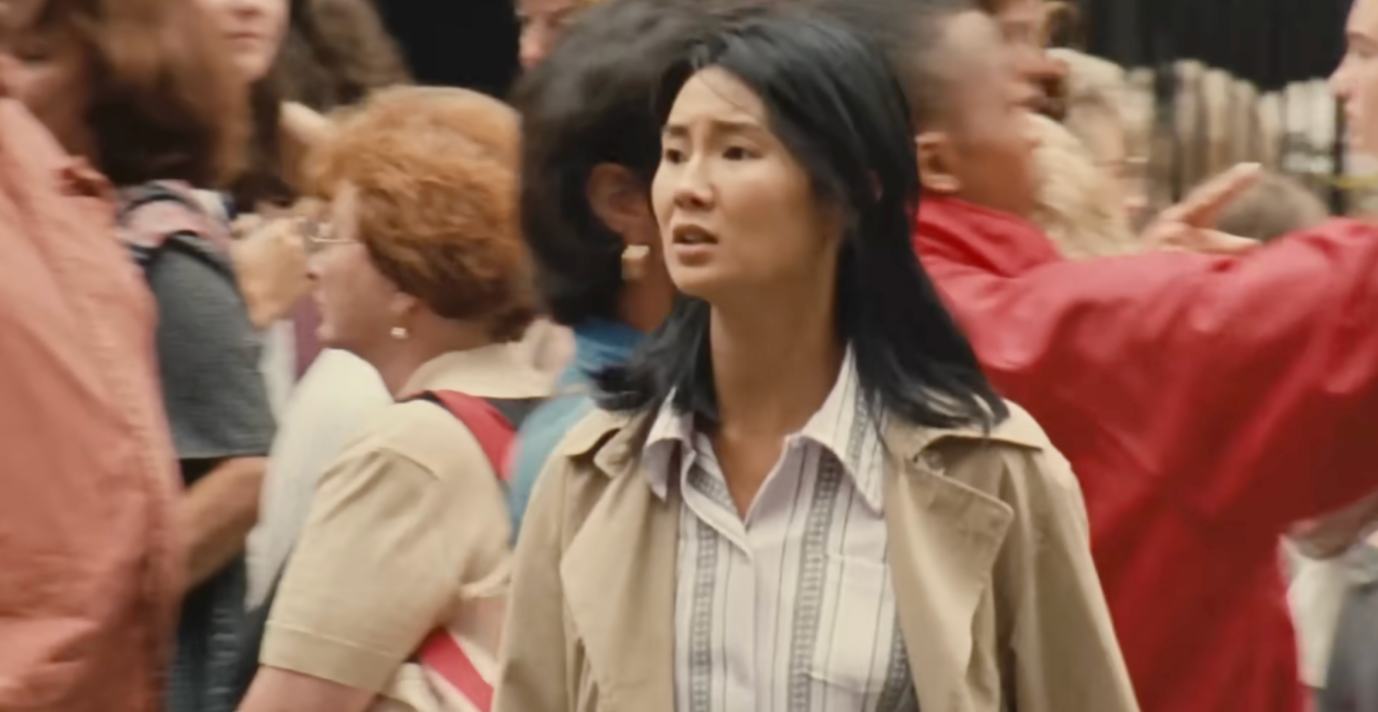
Qiao, against a sea of people near Times Square, having seen—briefly—Xiaojun, and lost him again.
This spatial consciousness extends to the film's most sophisticated formal choice: its use of temporal ellipsis. Chan collapses years into moments, allowing relationships to accumulate emotional weight through absence rather than presence. When Xiaojun and Qiao finally reunite in New York, the power of the scene derives not from what we've seen but from what we've missed—all the near-encounters, the letters unwritten, the phone calls unmade. It's a technique that mirrors how memory actually works: We remember not the continuous flow of life, but the isolated moments that acquire meaning only in retrospect.
The small synchronicities prevent the film from slipping into the melodramatic. They hint at the Chinese term “命”—translated literally as “life,” but in this context encompassing all variations of serendipity—and remind us that such a thing as fated romance does exist, but can only be reached through our most human faults and incessant yearning. In the face of modern society’s cynical takes on love, such a reminder is sorely needed.
The film’s incisive realization of the human psyche owes itself largely to Maggie Cheung’s spectacular performance. Her Li Qiao is pragmatic, at times ruthless—and yet, because she could be such a steel magnolia, she is uniquely capable of portraying devastating vulnerability. In a particularly striking scene, after they’ve stumbled in and out of bed together, Xiaojun is buying a bracelet for his sweetheart back home and invites Qiao along to help him pick one out. She goes; he buys two bracelets, and gives one to her. After a long silence, she berates him: “Actually I’ve never seen such a stupid person, giving the same bracelet to two different women. She’s your wife, I’m your friend…You have no idea what you’re doing.” Against the visual busyness of nighttime Hong Kong, the two of them are slightly frazzled, always slightly decentered from the camera, knocked off-balance; amidst the fraught negotiation of love and obligation, Qiao’s candidness takes on another dimension. She knows it’s wrong. She loves him anyway.
Comrades endures because it understands that the great romantic question isn't whether two people love each other, but whether they can inhabit the same emotional geography at the same moment. The film ends on a black-and-white replay of the initial scene, in which Xiaojun is sleeping on the train, resting his head against another passenger’s, about to disembark at Kowloon station. The camera pans out so we see that it is, in fact, Qiao’s head he was resting against: She was never a native to Hong Kong, as he’d thought and she’d wanted him to believe. They were both adrift, testing the waters of their dreams at the same time, unsure of the next place they might land. Beneath all the layers of who we wish we were, the same might be said of each of us.
Sources
[1] Shoard, Catherine. “Reboots and remakes: Why is Hollywood stuck on repeat?” The Guardian, July 6, 2025. https://www.theguardian.com/news/ng-interactive/2025/jul/06/reboots-and-remakes-why-is-hollywood-stuck-on-repeat.
[2] Migration Policy Institute, “International Migrants by Country of Destination, 1960–2024,” Migration Policy Institute Data Hub, accessed Nov. 18, 2025. https://www.migrationpolicy.org/programs/data-hub/charts/international-migrants-country-destination-1960-2024.
[3] “The Rise of Singlehood Is Reshaping the World,” The Economist, November 6, 2025. https://www.economist.com/leaders/2025/11/06/the-rise-of-singlehood-is-reshaping-the-world.