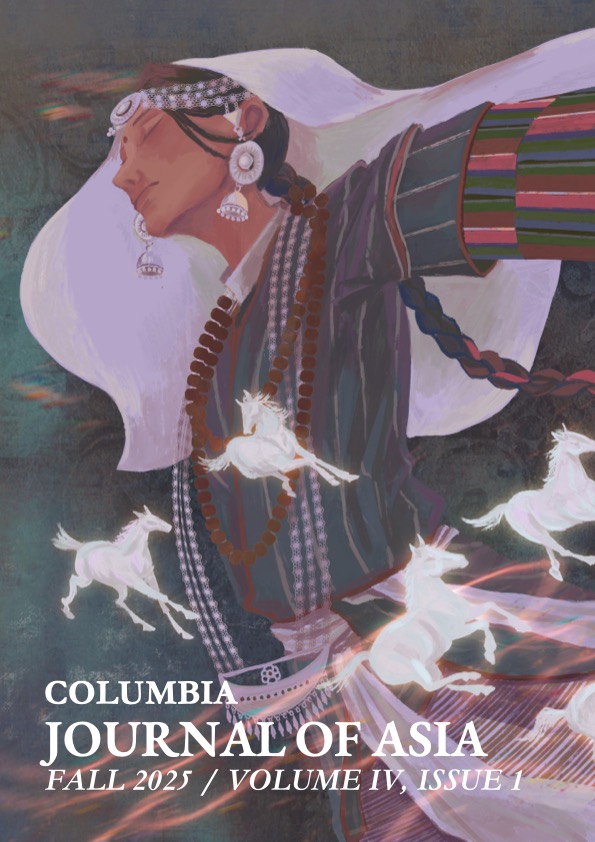
Vol. 4 No. 1 (2025)
It is our distinct pleasure to present the fourth issue of the Columbia Journal of Asia (CJA). Volume IV, Issue 1 features scholarly and creative works contributed by undergraduates and recent graduates representing academic institutions across Asia and North America. The issue is structured into two sections: Articles, comprising long-form academic research papers, and Creative Works, encompassing an array of artistic, poetic, and literary expressions.
Building on the preceding themes of our past two volumes, “Genealogies of the Orient(al)” and “Body Politics in the Orient(al),” and inspired by the questions posed by our selected works, this year’s thematic focus turns to the “Liminality of the Orient(al).” The works featured in this issue span a wide range of disciplines including history, archeology, anthropology, architecture, and the arts—and put in conversation, they illuminate the various multitudes and boundaries of liminality. These include social boundaries related to visibility, play, violence, and gender; material and metaphysical boundaries related to immortality, decay, and idealized and lived realities; and geographic and spatial boundaries, shaped by colonial and imperial metropoles and their peripheries. In light of these tensions, this issue seeks to consider what is the role of liminality within binary structures, and more specifically, within scholarly and creative discourses. Do liminal spaces subvert, reconcile, or reiterate binaries? Are they sites of contested negotiation or amorphous fluidity? And what may be the (un)productive consequences of characterizing a space as liminal? In accordance with CJA’s aim, we hope that this issue’s theme will help destabilize notions of a single, stable, and monolithic “Orient(al),” and instead, prompt readers to further engage with the complicated, and sometimes contradictory, narratives put forth by diverse voices.