
Over the course of this administration, several articles have detailed the MAGA efforts to restructure the population of the United States. Last month, New York Times contributors Jazmine Ulloa, Allison McCann, and Jennifer Medina reported on the detention of several U.S. citizens of Latino heritage being taken into custody across the country1. Since the Supreme Court2 has put a hold on the order barring stops based on a person’s apparent race or ethnicity or other factors that suggest they are Latino, such as speaking Spanish or accented English, I.C.E. agents have free rein to execute the Eisenhower-esque vision of the United States held by Donald Trump’s administration. At the same time as our neighbors and residents are being expelled for their appearance, culture, and language, reproductive health care for those this administration has deemed eligible to “stay” have faced dramatic changes. Access to abortion and contraception are becoming increasingly difficult while conservatives tout “natural” approaches to infertility. Another NYT article titled, “Under Trump, a New Focus for a Birth Control Program: Helping Women Get Pregnant”3 notes recent developments under Title X to clinics specifically targeting low-income women. What these articles fail to address is that these issues are not separate at all.
A few months ago, I held an internship with the largest organization of former democratically elected world leaders. From their headquarters in Spain, I researched democracy while watching it deteriorate in my home country from afar. I was taking notes in a meeting between our researchers and emeritus world leaders when the former Canadian Prime Minister pointed out that we cannot have a conversation about immigration without also discussing reproductive freedom. She explained that the rise of far-right political movements, declining fertility rates, and anti-immigrant sentiments in her southern neighbor (read the United States) are all related. Fertility rates are declining below the rate of replacement across the Global North, leaving a shrinking working population to support pensions.
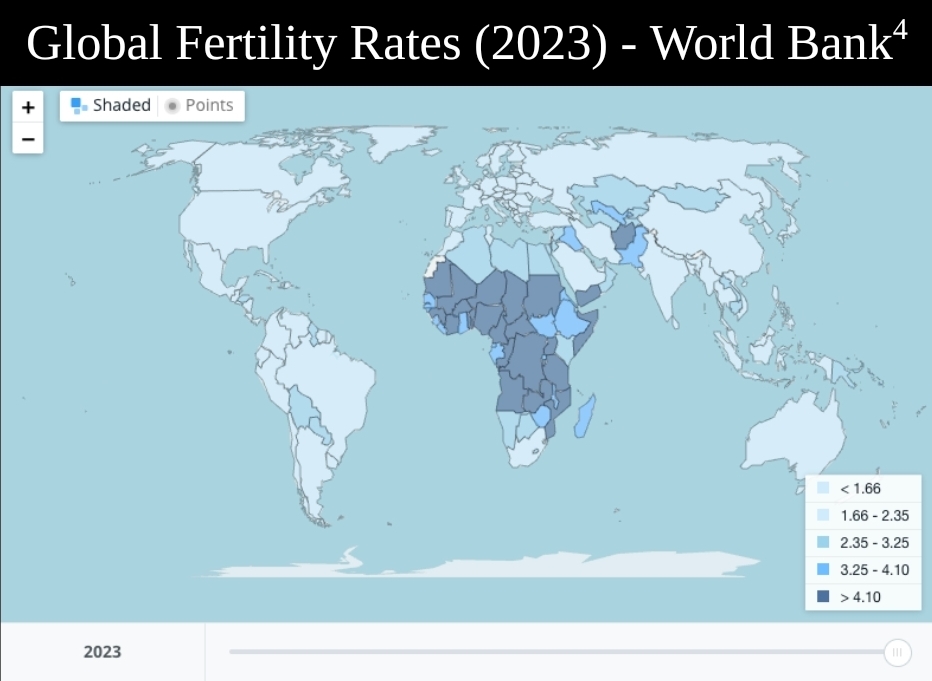
In other words, there aren’t enough young working people to support old retired people. So, the question concerning many policy-makers becomes How do we get more people? For those of you playing at home, you might be inclined to buzz in and say Make immigration easier! And while that would be a fine answer, unfortunately, it’s not what the far-right political movement in control of all branches of the U.S. government is thinking. As the Center for the Study of Organized Hate puts it, “the ideological spine of global far-right movements…[is] the belief that a nation should be exclusively inhabited and ruled by a homogenous, ‘native’ group, defined not by modern notions of citizenship and law, but through markers like religion, race, blood, culture or civilizational belonging.”5
Looking back at the more-people-problem from the perspective of a MAGA-aligned politician, the answer looks a lot like The people who look like me need to have more children. The MAGA movement, much like other far-right movements around the world, responds to declining fertility rates by forcing those who fit within their mold to reproduce, populating a homogenous culture that rejects diversity, equity, and inclusion. And though immigration and reproductive policy have been painted as separate, even disparate, issues in the U.S., in reality, they are two sides of the same racist, white supremacist coin.
As people, our bodies are canvases upon which social constructions of difference are mapped6. Immigration and reproduction can both be understood in terms of where our bodies are from, where they go, and what they do. As such, both are vulnerable to racism, which in turn can be understood as an irrational hatred based on those constructed differences. Indeed, the first reproductive policies in the United States were objectively and clearly rooted in racism7.
As a social work student, I have learned that all issues are intersectional, and that we must recognize the complexities existing within ourselves to understand those within our institutions. As a matter of rhetoric, immigration and reproduction have been siloed as issues that merely affect immigrants and people with uteruses, respectively. However, much like how light through a prism can be seen as “white” light or all of its constituent colors, our ability to understand these issues depends on the perspective we use to view them.
Zooming out, we may see that the problems undergirding this administration's immigration and reproductive policy are, at their core, the same. This is important for two reasons: 1) better understanding the problem makes us more able to conceive of a solution, and 2) it helps more people understand how they are affected by policy and, hopefully, feel more motivated to change it. For example, it would behoove liberals in the United States who want to protect the rights and dignity of both immigrants and birthing people to find a solution to the pension problem that does not depend on either demographic’s exploitation. For those of us working on social policy, especially in the U.S., especially now, and especially on these issues, we must be explicit about how these harmful policies work in concert with each other and how they perpetuate a system of inequality and white supremacy.
1. "I'm from Here!": U.S. Citizens are Ending Up in Trump's Dragnet- The New York Times
2. 25A169 Noem v. Vasquez Perdomo (09/08/2025
3. Under Trump a New Focus for a Birth Control Program: Helping Women get Pregnant- The New York Times
4. World Bank Fertility Rates Map (2023)
5. Mapping the Ideological Core of Far-Right Movements Globally
6. Full Article: Body Politics
7. The Racist History of Abortion and Midwifery Bans|American Civil Liberties Union