
Sometimes, art can speak to people in ways that just text cannot. However, an explanation can be beneficial to fully understand art.
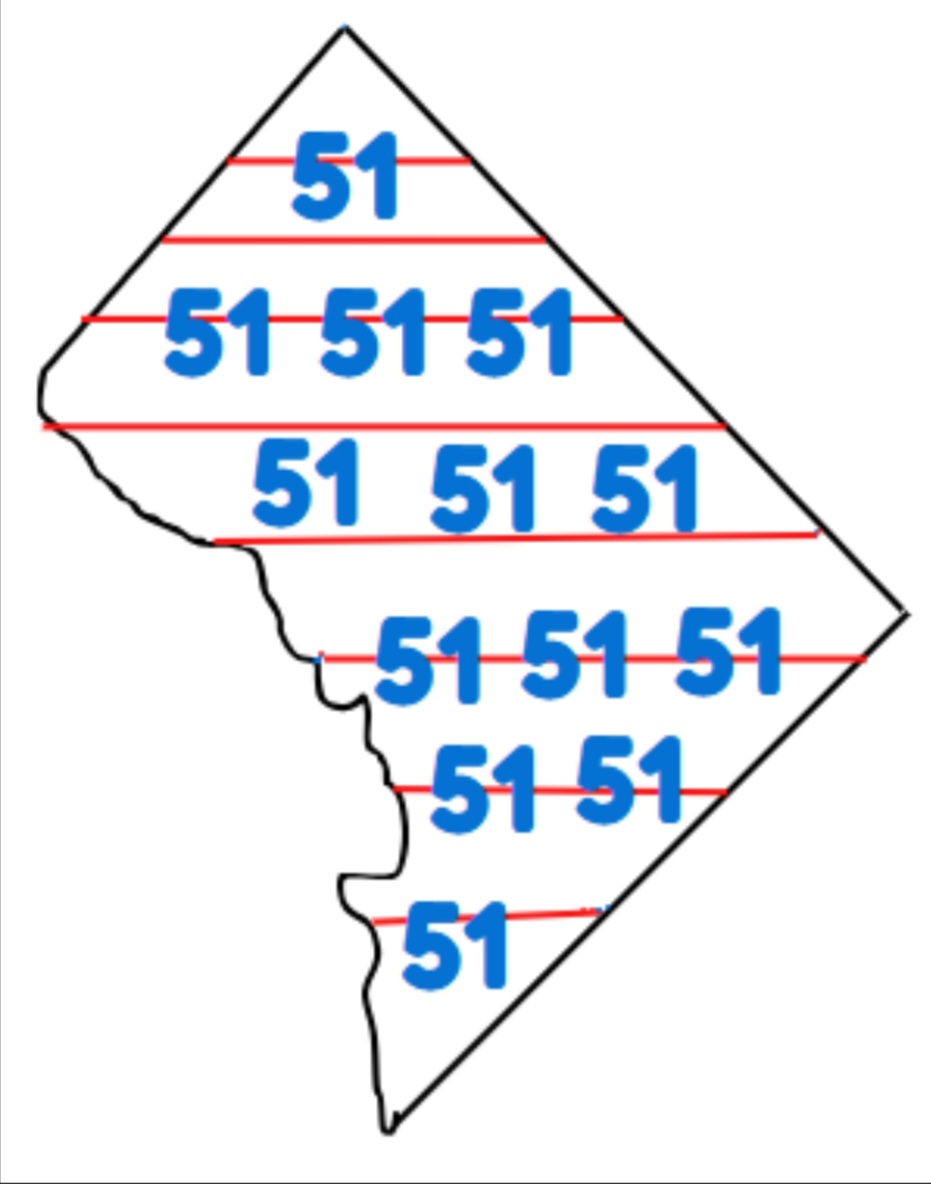
While I attended the Day of Action at the National Portrait Gallery in the District of Columbia on January 26, 2025, I was inspired to create the image relating D.C.’s unique status in the United States. As a native Washingtonian, D.C. statehood and the related subjects of D.C. autonomy and Congressional interference in local D.C. issues are very important to me. After interning for a local organization, I founded and led a student organization in my college about and wrote my senior thesis in undergrad about D.C.’s lack of Congressional voting representation in the U.S. Congress. I am currently active in the movement for D.C. autonomy. While participating in an art activity at the Day of Action, I knew I had to make a graphic about D.C. statehood.
The graphic depicts a map of Washington, D.C. originally was a diamond created from land of both Maryland and Virginia. However, in the late 1840s, Virginia took back its land, causing D.C. to have its current shape. The retrocession of land to Virginia creates the precedent of the District of Columbia losing its land. If D.C. were to become a state according to current plans, most of D.C. would become a state while the Federal District would be made much smaller.
The map is outlined in black to show D.C.’s plurality African-American population, which is related to efforts of denying full citizenship of D.C. residents. As D.C.’s Mayor Muriel Bowser testified to the House Oversight and Government Reform Committee on March 22, 2021:
Historic records are replete with statements of successive members of Congress referencing the “negro problem” and the “color problem” within DC as a justification to withhold Congressional representation. This was their way of saying that African Americans are unable to govern themselves, or vote for their best interests, and should therefore be denied political power and suffrage.
The map’s interior has features of both the D.C. and U.S. flags. D.C.’s flag includes two red horizontal bars beneath three red stars on white. The U.S. flag has seven red stripes and six white stripes. The map has eight horizontal lines, representing D.C.’s eight wards, on white. A ward is a geographic area that elects its own representative to the D.C. Council, which is D.C.’s unicameral legislature that also have five at-large seats. The map does not have a star because D.C. is not a state. The U.S. flag still has fifty stars, one for every state.
The map’s red lines are akin to the slats in jail cell doors. In many states, convicted felons lose the right to vote. When U.S. citizens live and vote in D.C., they lose their right to vote for Members of Congress. Washington, D.C., has one non-voting delegate in the House, but no representation in the Senate.
The map’s lines are horizontal while many of the slats in jail cell doors are vertical. The horizontal lines show how unique D.C. is in the world and the U.S. D.C. is the only national capital of a democracy whose residents do not have equal voting rights in the national legislature. D.C. residents have one non-voting representation and no representation in the U.S. Senate. As Members of Congress like to hear from their constituents who elect them, D.C. residents have no voting Members to turn to regarding policy. The District of Columbia is the only non-state to vote in the Electoral College for President. It is also the only jurisdiction in the U.S. without authority to choose its own judges and control its National Guard. D.C.’s situation makes D.C. residents second-class citizens without full power over its own local issues and little to no influence over national and international issues.
“51” signifies D.C.’s efforts to become the U.S.’s fifty-first state. In November 2016, 79 percent of D.C. residents voted for D.C. statehood.
“51” is blue for multiple reasons. With blue, the graphic contains the U.S.’s flag’s three colors: red, white, and blue. Blue represents the following about the U.S.’s ideals and D.C.’s situation: justice and vigilance. It is not fair that the U.S. became a country because colonies were taxed while they did not have representation in the British parliament and then proceeds to subject D.C. residents to the same taxation without representation scheme. The irony lies in that D.C. residents do not truly control local issues or have any voice in national and international affairs. D.C. residents have perseverance. They have been striving for fair treatment for decades and will not stop until D.C. becomes a state.
“51” appears 13 times, representing the U.S.’s original 13 colonies (just like the U.S.’s flag’s 13 stripes do). The 37 remaining states all became a state after the President signed a bill into law. Thus, D.C. could become a state in the identical way. A Constitutional amendment is not necessary for D.C. statehood, as it has never been the process used to admit new states.
While I attended the Day of Action at the National Portrait Gallery in the District of Columbia on January 26, 2025, I was inspired to create the image relating D.C.’s unique status in the United States.
D.C. must become a state. Its residents deserve to be full-class citizens, not the subject of taxation without representation with limited self-governance. If D.C. became a state, then D.C. residents would finally enjoy the rights that our nation’s Founding Fathers fought for centuries ago. As Senator Chris Van Hollen (D-MD) said:
Every American should have a full vote in our country’s future, but we fall short of this promise every day that the residents of the District of Columbia are denied that right in Congress and subjected to taxation without representation. We must grant the District statehood – the people who live in our nation’s capital deserve the same basic political rights afforded to citizens across the fifty states.